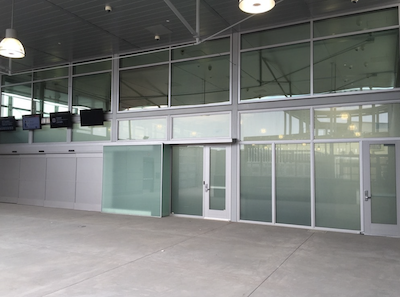
The risk of blast-related incidents, whether intentional or accidental, is no longer limited to military zones or foreign embassies. From federal buildings in urban centers to data infrastructure hubs and critical public utilities, blast events are an increasingly important consideration in building design.
Whether caused by explosive devices, industrial malfunctions, or nearby infrastructure failures, a blast wave doesn’t just impact a facility’s structure—it exerts intense pressure on windows, entry points, and wall systems, often resulting in dangerous shrapnel and structural damage.
As a result, architects, engineers, and security professionals are turning to standards like ASTM F2248 to guide their glazing system designs. This standard gives you the framework to ensure laminated glass systems are specified to withstand the pressure of modern threats when occupant safety and building continuity are on the line.
What Is ASTM F2248?
ASTM F2248, officially titled “Standard Practice for Specifying an Equivalent 3-Second Duration Design Loading for Blast Resistant Glazing Fabricated with Laminated Glass,” is a design methodology rather than a test protocol.
It provides a standardized approach for calculating how much static pressure laminated glazing must resist to mimic a real-world blast scenario that lasts three seconds or less.
What makes this standard especially useful is its adaptability. Unlike rigid pass/fail testing methods, ASTM F2248 empowers engineers to model glass behavior based on a wide range of inputs:
- Expected blast pressure
- Distance from the blast source (standoff)
- Size of the glazing panel
- Thickness of interlayers
- Framing conditions
The standard recommends that laminated glass be constructed using either annealed or heat-strengthened glass plies, as these materials offer more reliable performance than fully tempered glass.
What the ASTM F2248 Standard Does (and Doesn’t) Do
It’s important to understand what ASTM F2248 is intended to provide and what it doesn’t.
The standard outlines how to derive a calculated load value that reflects the effects of a short-duration blast on laminated glass. That value can then be applied in testing environments or engineering simulations to assess performance.
For example, once the equivalent static load is calculated using F2248, it can be used to:
- Model how a glazing system will perform under stress.
- Evaluate whether anchoring systems and frame designs are appropriate.
- Inform product selection for third-party dynamic testing, such as ASTM F1642
In short, F2248 establishes the design criteria, but it doesn’t confirm whether a particular system has met it. That confirmation happens through additional testing or analytical validation.
When and Where ASTM F2248 Applies
F2248 is most commonly used in facilities where blast protection is a primary concern but may not rise to the level of full military-grade hardening. It provides a performance benchmark that can be scaled based on the facility’s risk profile.
You’ll typically find F2248 applied in:
- Government and civic buildings where security and public access must coexist.
- Utilities and critical infrastructure, such as power plants and water treatment facilities.
- Urban data centers and communications hubs that require high operational continuity.
- Financial institutions, particularly in major metropolitan areas.
- Buildings near industrial zones or transport corridors where accidental explosions may occur.
Integrating ASTM F2248 Into Your Design Process
Incorporating F2248 into a project requires close collaboration between architects, engineers, and security consultants, especially during the design development phase.
It begins with assessing the threat environment: What kind of blast load is realistic based on building location and use? From there, teams can apply the F2248 methodology to calculate equivalent design loads for specific glass and framing systems.
This step isn’t just about math. It’s about identifying points of vulnerability, where a pressure wave is most likely to breach the building envelope, and confirming the selected laminated glass system is not only appropriately rated, but integrated with compatible framing and anchoring strategies.
Because laminated glass alone cannot absorb or redistribute the energy of a blast, any design load must account for the entire system’s response: the frame, supports, and surrounding structures.
F2248 helps provide a realistic and standardized way to model that interaction so you’re not over- or under-building critical areas of protection.
Please note: Total Security Solutions does not offer any blast-rated products, but we can advise you on appropriate physical security standards, including bullet-resistance and forced entry resistance.

Frequently Asked Questions
What is blast-resistant glazing comprised of?
The core of blast-resistant glazing is laminated glass fabricated with multiple layers of glass and polymer interlayers that hold together under pressure.
To be effective, the system also includes:
- A blast-rated structural framing system
- Secure anchoring hardware
- Compatible sealants and spacers
All components must work together to perform under the design loads calculated using ASTM F2248.
What is the difference between annealed and heat-strengthened glass?
Annealed and heat-strengthened glass plies can be used to construct laminated glass, but they differ in strength and how they respond to stress.
Annealed glass is untreated and more flexible, but breaks more easily. Heat-strengthened glass is about twice as strong and better resists thermal and mechanical stress, while maintaining a similar break pattern.
Blast testing has shown that fully tempered glass plies have poorer post-blast performance as compared to annealed or heat-strengthened glass plies.
What does "equivalent 3-second duration" mean in ASTM F2248?
It’s a way to simplify a blast event into a static pressure load. Instead of modeling the full dynamic blast, ASTM F2248 calculates the equivalent pressure that, if applied uniformly for three seconds, would produce the same effect on laminated glass as the actual blast. This makes blast design easier using standard engineering tools.
What’s the difference between ASTM F2248 and ASTM F2247?
ASTM F2248 is a design standard used to calculate the equivalent static pressure a laminated glass system should resist to simulate a blast. ASTM F2247, on the other hand, is a test standard that outlines how to physically test glazing systems using a shock tube to simulate a blast event.
In short:
- F2248 = Design calculation
- F2247 = Physical blast test
Both are used in blast-resistant glazing projects, but serve different purposes.
Can insulating glass fabricated with laminated layers meet ASTM F2248?
Yes, insulating glass fabricated with laminated components can be designed to meet ASTM F2248, provided the inner laminated lite is engineered to withstand the calculated blast load. However, performance depends on more than just the glass; it must also be evaluated as part of the complete framing and anchoring system.
Related Resources

Ballistic Glazing Solutions Guide

The 8 Levels of Bullet Resistant Glass

Guide to Improving Physical Security By Addressing the Human Factor
