NIJ 0108.01 is a ballistic-resistance standard developed for armor—not buildings—and using it to evaluate bulletproof construction materials can lead to misleading assumptions about protection.
Whether you’re protecting employees, visitors, or assets, you need to know the ballistic barriers put in place will hold up to a real-world threat. A material labeled “NIJ rated" sounds reassuring, but is it the right rating for your building?
The answer is: not always.
The NIJ 0108.01 standard is a real ballistic standard, but it was not designed for architectural products. It doesn’t provide the level of testing detail or system-based evaluation required for doors, windows, walls, or building enclosures. If you’re unfamiliar with how ballistic standards differ, it’s easy to assume NIJ and UL ratings are interchangeable; they're not.
Understanding where NIJ 0108.01 applies can help you make smarter, safer decisions when specifying materials for your building.
What Is NIJ 0108.01?
Published by the National Institute of Justice, NIJ 0108.01 is a performance standard for ballistic-resistant armor materials. It’s used to evaluate whether protective panels—such as those used in shields, vehicle inserts, or tactical armor—can withstand gunfire.
Specifically, the standard applies to flat ballistic materials intended to stop bullets. It does not include performance requirements for integrated systems, nor does it provide the detailed testing procedures necessary to evaluate architectural products like bullet-resistant glass or fiberglass used in commercial or institutional construction.
As the NIJ outlines, the standard does not cover police body armor or ballistic helmets (those fall under other, more specialized standards), and it was never intended as a guide for building barrier systems.
So, while NIJ 0108.01 has legitimate applications in the law enforcement and defense sectors, its usefulness in building security is limited. Yet despite that, it’s often referenced in product descriptions, creating confusion for architects, general contractors, and end users who assume it provides equivalent verification to other, more relevant standards.
How NIJ 0108.01 Ballistic-Resistant Testing Works
The NIJ 0108.01 testing method is straightforward. A sample material is placed in front of a witness panel: a thin sheet of aluminum designed to detect penetration. A single bullet is fired at the material using a specific weapon and ammunition type. If the bullet, or any fragments of it (or the test material itself), fully perforates the witness panel behind it, the sample fails. If not, it passes.
In the words of the standard itself: “Only a complete perforation of the witness panel, whether by bullet fragments or material from the test sample (spall), shall be classified as a ‘penetration.’ Impacts which produce any other results will be classified as ‘no penetration,’ regardless of the risk of injury.”
That final clause is important. A product could sustain visible damage, send dangerous fragments flying, or deform significantly and still technically be classified as “no penetration.” That may be acceptable for body armor or mobile shields, where the user is trained, protected, and prepared to be in proximity to impact. But for a window or door protecting an occupied space, this level of assessment may not offer the safety or reassurance needed.
More critically, NIJ 0108.01 does not test ballistic-resistant protective materials as part of a larger system. There are no requirements for evaluating how a material performs when framed, anchored, or mounted. It doesn’t address structural considerations, forced-entry threats, or the kinds of repeated impacts often seen in active shooter events.
In short: the NIJ test tells you whether a material can stop a single bullet in a lab, not how it will perform in the real world as part of a building’s security envelope.
Where the NIJ Standard Fits (and Where It Doesn’t)
NIJ 0108.01 remains an important benchmark for law enforcement, corrections, and military applications. If you’re selecting a portable shield, retrofitting a vehicle with armor panels, or specifying tactical gear, NIJ ratings can be helpful. But in architectural settings, NIJ 0108.01 has significant gaps.
Appropriate uses for NIJ 0108.01 include:
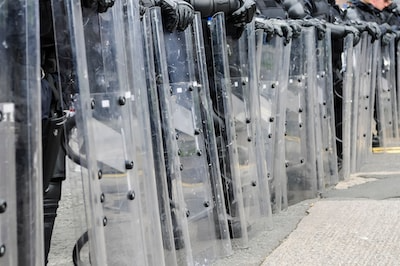
- Tactical or riot shields
- Portable ballistic panels
- Vehicle-mounted armor
- Personal protection equipment
Inappropriate (or insufficient) uses include:
- Ballistic glass in windows or storefronts
- Bullet-resistant reception barriers or teller lines
- Doors, wall panels, or structural framing
- Secure entry vestibules or mantraps
This isn’t just a technicality—it’s a matter of functional safety. When materials are used in environments with foot traffic, glass exposure, or forced-entry risks, you need a system-level standard that evaluates how all components work together to provide protection.
NIJ vs. UL 752: Why the Difference Matters
In commercial construction and architectural security, the most widely accepted ballistic testing standard is UL 752, published by Underwriters Laboratories. Unlike NIJ 0108.01, UL 752 was specifically designed to test building materials and assemblies used in public, commercial, and institutional settings.
UL 752 evaluates materials like ballistic glazing, wall panels, doors, and transaction windows under a variety of real-world conditions. Each level of the UL scale corresponds to a specific firearm and ammunition type, with clear shot placement, spacing, and round count requirements.
Most importantly, UL 752:
- Requires third-party verification from accredited labs
- Has clearly defined protection levels (Levels 1 through 10)
- Is often required or referenced in building codes and specifications
While the NIJ standard is often referenced in law enforcement projects, it does not require third-party validation and does not address architectural context. When reviewing materials as “NIJ rated,” it’s essential to understand what was tested and if that testing is meaningful in your application.
The Problem With “NIJ Rated” Ballistic-Resistant Protective Materials in Architecture
You may come across materials that claim to meet NIJ standards. While that may be technically true for a raw material sample, it doesn’t mean the installed system—window, door, or barrier—has been tested to perform in your environment.
This is where the language gets murky. A product that "meets the requirements of NIJ standards" is not necessarily NIJ compliant. Even if it were, that wouldn't guarantee performance in a construction context.
Compare that to UL-rated systems. When a manufacturer claims their product meets UL 752 Level 3, they can provide third-party test documentation showing that the material or the assembly was successfully tested to stop three rounds from a .44 Magnum under specific, controlled conditions.
The same clarity doesn’t exist with NIJ ratings applied to architectural products, which is why UL 752 remains the gold standard in this space.
Need Help Navigating Ballistic Standards?
We understand how complex ballistic standards can be to understand and apply effectively. At Total Security Solutions, our experts walk you through the entire process, from evaluating threats to selecting tested, proven systems that meet your goals, budget, and compliance requirements.
Let us help you sort through the noise and focus on what works. Contact us today.

Frequently Asked Questions
Is NIJ 0108.01 the same as “NIJ IIIA” or “NIJ Level III”?
Not exactly. NIJ 0108.01 is a general standard for ballistic-resistant materials, but the levels (like Level IIA, IIIA, III, IV) refer to specific classifications used in body armor testing, often under NIJ 0101.06 or 0101.07 (a separate standard altogether). So when you see “NIJ IIIA,” that usually refers to soft body armor versus building materials.
Is it a red flag if a product only references NIJ ratings?
Not always, but it’s definitely worth a closer look. NIJ 0108.01 has legitimate uses in some protective applications. However, if a manufacturer is promoting an NIJ rating for a commercial construction product, and can’t provide UL 752 testing data or third-party documentation, that’s a good reason to ask more questions.
Can a product be both NIJ and UL-rated?
Technically yes, but the two standards measure different things. A product might be tested to NIJ 0108.01 as a flat panel and also be part of a UL 752-rated system. If you’re securing a facility, the UL rating should be your benchmark.
Jump to a Topic:
Related Resources
Our goal is to help you make informed decisions that protect your people, secure your assets, and support your mission—without sacrificing design or functionality. These resources offer guidance for your project.

Ballistic Glazing Solutions Guide

The 8 Levels of Bullet Resistant Glass

Guide to Improving Physical Security By Addressing the Human Factor
