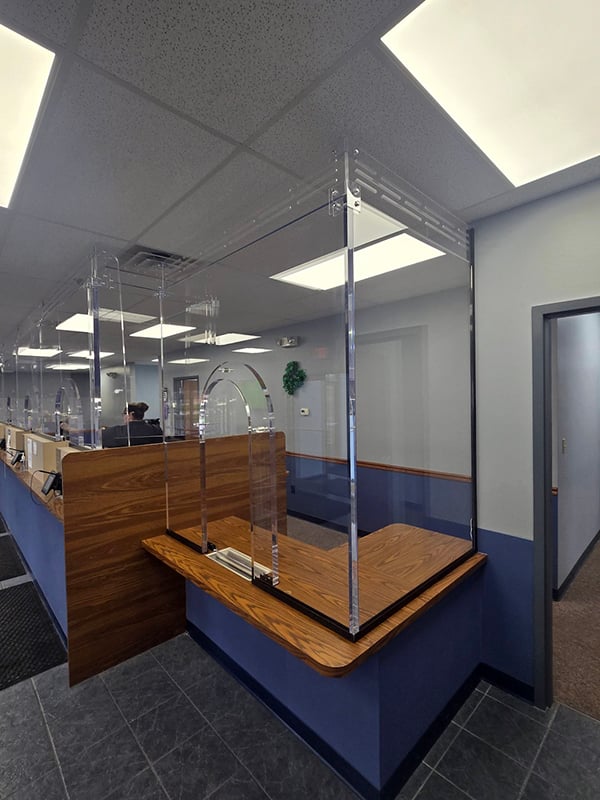
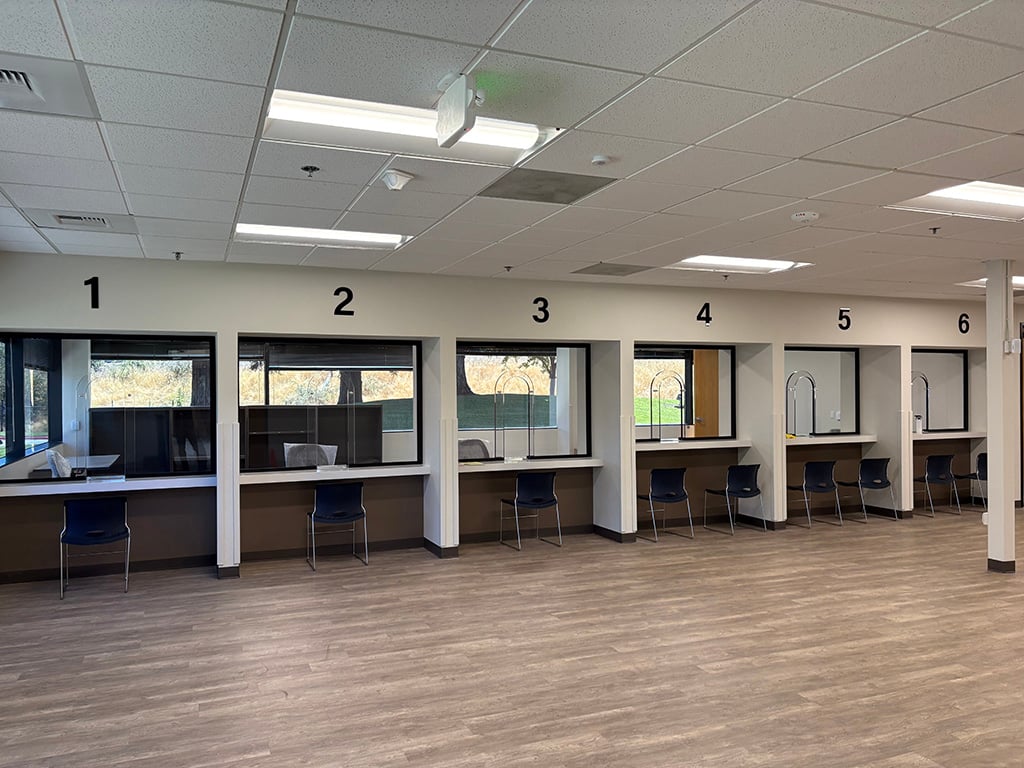
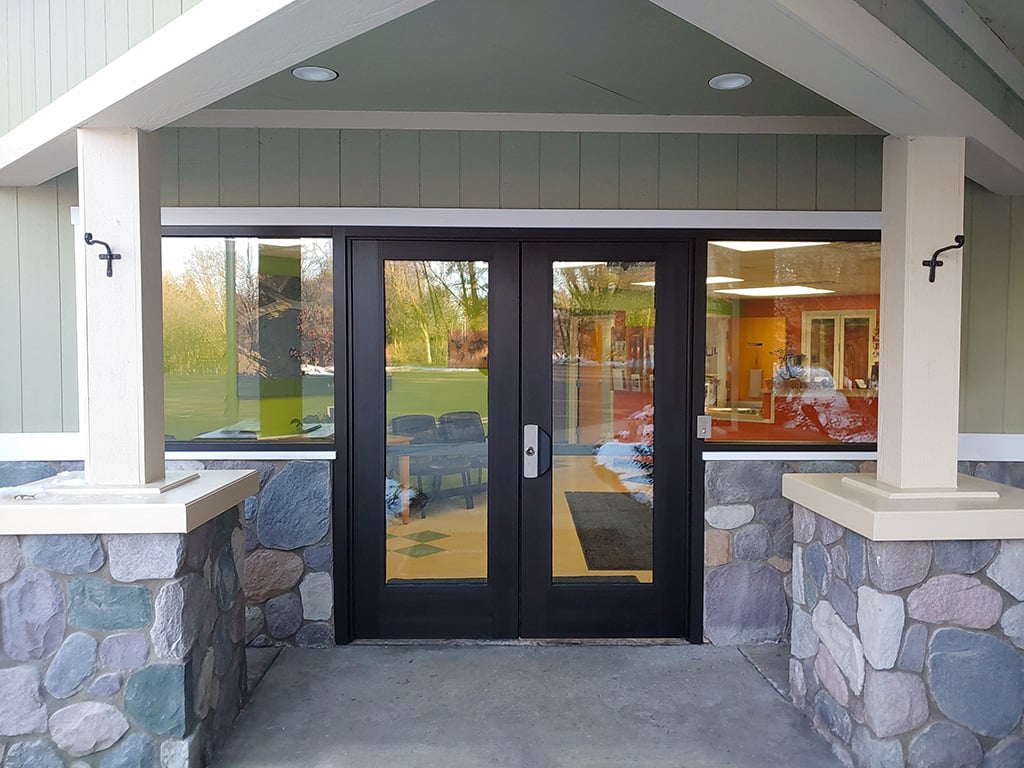
With more than three decades manufacturing bulletproof security systems, Total Security Solutions is the industry leader for custom bullet resistant barriers that meet your bulletproof security needs on-time, on-budget, and expertly finished.
Jim Richards, vice president of Total Security Solutions, has been around long enough to have seen his fair share of bad ideas for bullet proof systems. Jim was recently reminded of one project he was asked to bid on:
A national-chain big box store on the fringe of a suburban community had suffered a series of night-time raids. The result: thieves had hijacked several of the store’s big rigs and semi-trailers. A designer working on the store’s renovation called Total Security Solutions, looking to beef up security with bullet proof glass, fiberglass, frames, and a reinforced door for the storage lot’s guard booth.
PROBLEMS BULLET PROOF GLASS CAN’T CURE
When Jim arrived on site he was surprised to learn that these daring night-time raids hadn’t been at gun point; workers had simply discovered the trucks missing in the morning, with nary a peep in the night.
“I don’t know what securing the guard booth was supposed to accomplish; bullet proof glass windows aren’t gonna keep people people from stealing the trucks if no one is paying attention. I mean, the day we went there and measured it, we just drove right up through the gates and started poking around without anyone raising an eyebrow.”
Jim talked the owners out of installing bullet proof glass. “A lot of times it’s just that a designer gets an idea in his head,” Jim sighs. “That seems to be more the trend than practicality. I’ve seen systems installed completely backwards because that’s how the designer wanted to do it.”
EDUCATING CLIENTS ABOUT BULLET PROOF GLASS
A company like Total Security Solutions, which deals in a relatively esoteric product, expends as much effort on educating potential customers as they do on actually designing and installing bullet proof glass systems. Over the years Jim has found that it’s often easiest to educate the clients themselves, as opposed to the designers they’ve hired to renovate a facility. Even though the clients are much less likely to have a designer’s or architect’s familiarity with building materials, construction methods, and engineering, the clients are much more motivated to understand how a ballistic glass system is actually going to keep then and their employees safe. “The problem with bad designers is that they see bullet proof glass as such a small part in the scheme of things. If someone is building a $25 million building, and the bullet proof system is $40,000 of that job, that’s just a drop in the bucket. It’s really the least of a designer’s concern, and often an afterthought.”
AESTHETICS OVER FUNCTION
All too often Jim has found himself struggling with a designer who sees bullet proof systems as largely aesthetic, instead of functional. “I’ve seen designers make decisions, changing the level of protection, based on how the glass looks rather than threat-level. I’ve had designers insist on using materials or components in situations where the products simply won’t work. The designer will push it through, and then end up having to make modifications and alterations after the fact.”
MAKING SECURITY A TOP PRIORITY
The designer–by the nature of his work and training–is primarily interested in aesthetics: His career hinges on how good a building looks as pictures in his portfolio. The designer doesn’t have to spend every day working behind that bullet proof glass, and will never need to trust it with his life.
“If you can talk directly to the clients, who will be the end users of that bullet proof glass system, and walk them through the process, then usually you can dissuade them from doing anything too odd. But if you’re dealing with some designers–especially less experienced ones–they get something in their minds, and it’s almost impossible to change.”
It’s almost become run-of-the-mill for a large-scale ballistic system to incorporate huge six-foot by ten-foot pieces of ballistic glass. Such “supersize” bullet proof windows are, in essence, no different from their little brothers: A bullet resistant transparency (made from monolithic acrylic, polycarbonate, glass-clad polycarbonate, or laminated glass) is held in place by a bullet resistant frame(either a hardened-aluminum True Level 3 frame, an all-steel frame, or a Level 4+ fiberglass-lined aluminum channel frame). According to Total Security Solutions vice president Jim Richards, “it’s not uncommon to install a 30- or 40-foot bank of large windows like that.”
BULLET PROOF WINDOWS AND INTERIOR DESIGN
Jim doesn’t tend to install bullet proof windows larger than six-foot by ten-foot, but that’s only because it’s unusual for customers to want anything larger. Jim is quick to point out that this isn’t a limitation, so much as a popular fashion. For aesthetic reasons–and to prevent inattentive guests and customers from walking into nearly invisible glass walls–designers usually want to break up a large wall of ballistic glass with mullions or other supports (even if they aren’t structurally essential).
“Especially once you start getting into laminates like glass-clad polycarbonate,” Jim notes, ”you can go bigger, you just need to find a laminator with a big enough autoclave”–such as US Armor, a laminator Total Security Solutions has worked with extensively.
WHO NEEDS HUGE BULLET PROOF WINDOWS?
The most obvious application for such large windows are in the exteriors of banks and office buildings. Glass-clad polycarbonate bullet proof windows offer both bullet and blast resistance, as well as a forced-entry rating, and even a modicum of protection from severe weather, tornadoes, and tropical storms.
Large Bullet Proof Windows
But the most innovative use of these largest bullet proof windows is in dividing up interior spaces. By using large bullet proof windows in place of stud walls or other solid dividers, banks can offer privacy to customers meeting with their financial advisors without limiting the visibility of security personnel.
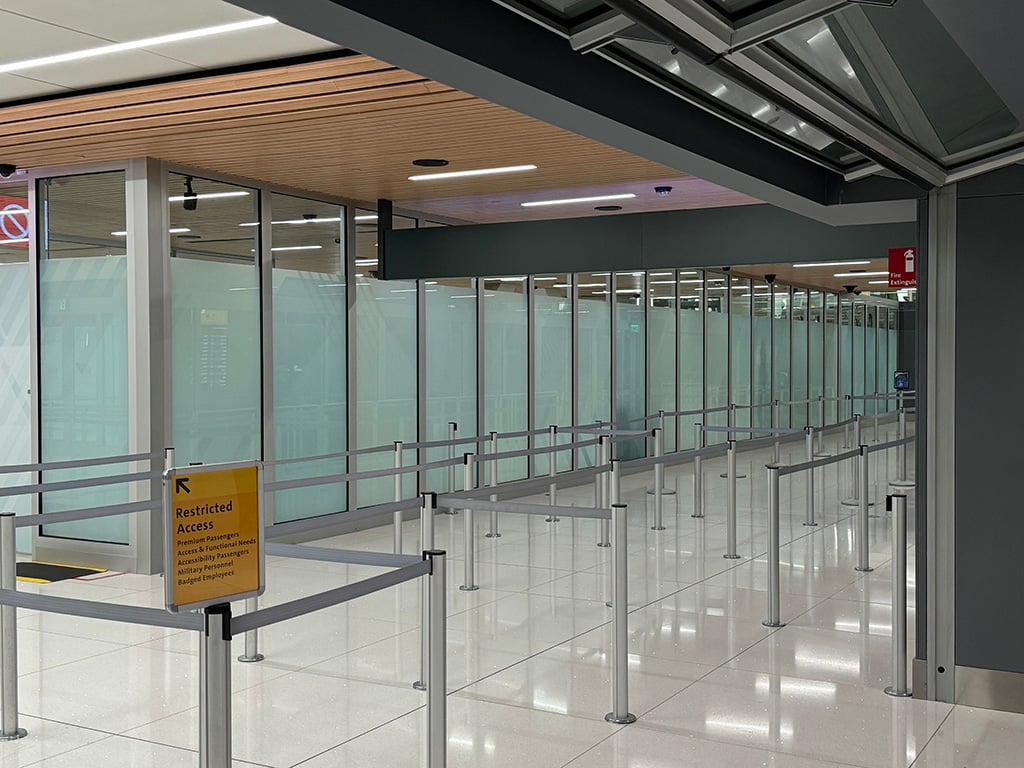
Large bulletproof windows have also become the standard way to cordon off and manage the security checkpoints and screening stations in airports. Large police stations likewise benefit from this solution, which allows them to manage visitors, maintain security, and literally keep their operations absolutely transparent to the public.
“Bullet proof” and “security” are so tightly intertwined for most of us that it’s often surprising to learn about modern facilities where security doesn’t hinge on ballistic glass. Prisons, for example–despite their reputation as modern-day fortresses–are almost devoid of ballistic glass. It simply doesn’t suit their setting.
BRITTLE, BUT STOPS BULLETS
Total Security Solutions vice president Jim Richards is an expert in ballistic systems design, and he points out that although it’s counter-intuitive, much ballistic glass is actually fairly brittle. This brittleness is vital to how the glass stops bullets: The extremely hard surface deforms the projectile upon impact, then cracks and chips–which saps the bullet of energy and deflects its forward momentum. The bullet, no longer streamlined or flying efficiently, grinds into the ballistic glass, chewing itself up in the process.
This is great for stopping bullets, but also means that these materials are relatively easy to scratch, and might be rendered foggy by a careless janitor (or sly inmate) “cleaning” the ballistic glass improperly.
LITTLE CALL FOR STOPPING BULLETS
Ballistic glass isn’t really what a prison needs. There are few guns behind bars, and all are tightly monitored. What is much more important than a ballistic barrier is having clear barriers–making it easy to monitor inmates–without having to worry about those barriers being damaged by either malice or carelessness.
As Jim explains, “Imagine you’re building a new prison; that’s a $20 million facility. There might be maybe $20,000 in new ballistic glazing and frames in the whole scope of the project, but you need lots and lots of durable windows.” To put that in perspective, a $20 million prison complex–which might comprise several buildings on dozens of acres of land, and ultimately hold thousands of inmates–only includes a gas-station’s worth of work for a ballistic glass expert.
DETENTION GLAZING vs. BALLISTIC GLASS
What prisons and jails really need is “detention glazing.” This is half-inch thick polycarbonate, very similar to the polycarbonate used in some ballistic glazing. Polycarbonate is perfect for prisons because, unlike other ballistic glass, polycarbonate flexes and rebounds when struck. Detention glazing won’t stop a bullet, but the springy polycarbonate will deflect a rock or chair or hammer almost indefinitely.
When it comes to ballistic glass installation, reporters are fairly committed to a pretty simple narrative: crime steadily increases, a local business gets robbed, they install a ballistic glass system, and that either foils the bandits (often the case) or Something Goes Terribly Awry and the business once again falls victim (unlikely, but sure to make the evening news). That said, according to Total Security Solutions vice president Jim Richards, such “response jobs” are pretty rare.
A RATIONAL DECISION TO INSTALL BALLISTIC GLASS
“Everybody assumes that all this stuff is crime-related,” Jim says, “but that’s not usually the case. It’s people being proactive, not people responding to crimes.”
Take the humble gas station: During a single robbery a bandit is unlikely to snatch more than a couple hundred dollars. The average bullet proof system for a gas station (which will include, at minimum, a ballistic glass barrier to enclose and protect the cashier, bullet proof framing for that glass, a bullet proof door to access the protected area, a cash tray and talk-thru voice transmission system to make transactions possible, and several sheets of bullet resistant fiberglass paneling to reinforce the surrounding counters and walls) runs at least $20,000.
Every gas-station owner is, at heart, an economist, and the rational part of his brain is bound to ask: Am I likely to be robbed dozens, even hundreds, of times? If so, ballistic glass is a must. If not . . .other factors come into play.
CALCULATING THE VALUE OF BALLISTIC GLASS
Other factors argue for investing in ballistic glass. It may seem far-fetched, but statistical analysis shows that armed robbers engage in the same foraging behaviors indicative of all hunter-gatherer societies: When they find easy pickings, they go back over and over and over again. If you are those easy pickings, then you certainly are likely to get robbed over and over again (conditions permitting).
And, unfortunately, the vast majority of business robberies involve a weapon, and the vast majority of those weapons are guns. While a robbery involving a gun is less likely to be resisted (and thus less likely to turn violent), when it does turn violent, that violence is far more likely to be deadly: According to studies from the 1990s, robberies involving gun-totting bandits are three times more likely to end in fatality than those where the bandit is armed with a knife, and ten times more likely to result in a death than cases where the bandit is unarmed. Worker safety definitely weighs on the side of ballistic glass.
Finally, on the strictly monetary side of the equation, insurance companies very often offer rate reductions to businesses that install ballistic glass, with the largest savings going to retailers, financial services, and quick-serve restaurants in the highest crime areas. In any case, capital improvements, like a high-quality ballistic system, are bound to increase a property’s value.
MAKING THE CALL ON BALLISTIC GLASS
In the end, the decision to install ballistic glass is a very rational calculation based on a cold assessment of the business’s market, demographic, geographic region, and shifts in local economic and social conditions.
“It’s not something that, all of a sudden, because the store next door got robbed, owners say ‘We’ve gotta have this!’” Jim concludes, “Maybe an incident does push them along, but it’s not usually ‘Oh, we just had our first robbery! We’ve got to get a barrier put in!’ That’s very rare. They’ve run the numbers long before they decide they need ballistic glass.“
Acrylic and laminated bullet proof glass look pretty awful after being shot. That clear sheet is almost invariably rendered totally opaque by a froth of spiderweb cracks, and has often lost big hunks of glass–as well as countless tiny shards and flakes. It usually comes as a shock to realize that the glass has actually stopped the bullet, because it looks absolutely demolished.
Bullet proof glass after being shot
BRITTLENESS AS A FEATURE
In most regards, acrylic and traditional glass are very different materials–glass is much harder, acrylic much more malleable, and they share no common constituent materials or manufacturing methods–but both are brittle, and this brittleness is the key to their bullet-stopping power. In the case of traditional laminated bullet proof glass, individual sheets of tempered glass (which are pretty hard in their own right; just ask any hothead who’s ever tried to dramatically punch out a window) are adhered to each other with intervening layers of thin, rubbery epoxy. When a bullet strikes this laminated bullet proof glass, the hard surface of the first sheet flattens the bullet, then shatters. The rubbery layer of epoxy then saps away some of the rushing bullet’s momentum. If the bullet still has enough energy, it might shatter the next pane of glass–flattening even more in the process–only to get further sapped by the next layer of epoxy. After a few layers of glass that bullet is out of steam–and the window looks like hell.
Monolithic acrylic bullet proof “glass” (really a thermoplastic) is very similar to traditional laminated bullet proof glass, but it does it all in a single layer (and is thus “monolithic”): A bullet strikes the very hard surfaces of the acrylic bullet proof glass, breaking off all manner of sharp, thin flecks and shards (called “spall”). In the process, the bullet mushes itself into an exceptionally non-aerodynamic shape, and wastes a good deal of its energy. A normal sheet of ballistic acrylic is over an inch and a half thick, so even after shedding these chunks there is still enough acrylic left to deflect the bullet.
STAYING LOOSE TO STOP BULLETS
Meanwhile, polycarbonate bullet proof glass is a very different beast. This is graphically demonstrated in the following video clip, extolling the virtues of Oakley “Plutonite” sunglasses lenses. “Plutonite” is Oakley’s trademarked version of high-quality optical-grade polycarbonate. You’ll see how, when a projectile strikes polycarbonate, even a thin layer of totally non-laminated material will wiggle, wobble, rebuff the projectile, rather than cracking and letting it through.
To a layperson reading the papers, college campus security seems like a disconcertingly fast-evolving beast: one day the biggest worry is binge drinking, the next it’s armed robberies, “Virginia Tech”-style school shooters, or even terror attacks. Parents visiting campus may start to wonder: Shouldn’t these doors be bullet proof? Why aren’t these windows ballistic glass?
CAMPUS LIFE IS SAFE
First off, it’s important to make clear: College campuses are fairly safe. According to the most recent data from the U.S. Department of Education, violent crime has largely been declining on US college campuses, and the rate at which violent crimes are committed on campus has long hovered well below the overall US rates for the same crimes.
This matches the experience of Jim Richards, vice president of Total Security Solutions. “We do a little bit of college work,” he says, “but it’s isolated to traditional security concerns”–in other words, financially motivated crime. Total Security Solutions occasionally installs ballistic glass in campus police offices (which often enjoy the same Homeland Security grants as local police and sheriffs), but more often find themselves working in bookstores, payroll or financial services offices, campus credit unions, and the ticket offices at arenas and other venues.
What Jim doesn’t see is any demand–or need–for ballistic glass addressing “Virginia Tech stuff.” Here his experience matches the recommendations made by the Department of Education, FBI, and National Threat Assessment Center: Better monitoring–i.e., more security cameras and more personnel–and direct intervention (usually by counselors, residential advisors, or teaching staff) leads to diffusing violence well before it escalates to anything ballistic glass can protect you from.
DETENTION GLAZING vs. BALLISTIC GLASS
What is needed–especially at big sports schools, where emotions can run high following a major loss (or even a win)–is so-called “detention glazing.” This is half-inch thick polycarbonate–very similar to that used in some ballistic systems–first popularized in American prisons. Detention glazing won’t stop a bullet, but the springy polycarbonate will deflect a rock or chair or hammer almost indefinitely.
Ironically, this actually makes structural campus security a lot like prison security, with its focus on controlled access and monitoring of buildings. True ballistic glass is relatively uncommon in prisons: there are few guns behind bars, and all are tightly monitored. What’s more important than stopping bullets is having clear barriers–so it’s easy to monitor facilities–without having to worry about those windows being damaged by either malice or carelessness. The popularity of such half-inch glazing in detention centers is what gave “detention glazing” its name.
That college campuses form such a small part of the ballistic glass portfolio of companies like Total Security Solutions is indicative of how safe our institutions of higher learning are.
Total Security Solutions, the leading manufacturer and installer of bulletproof glass, recently began offering National Institute of Justice-rated Level 4 glass to its customers. This top-rated bullet resistant glass product offers added security for Total Security Solutions’ retail, banking and government customers.
To pass the Level 4 test, bullet proof glass must stop a shot from a .30-06 hunting rifle.
“Customers come to us wanting a product that meets their security and aesthetic needs,” said Jim Richards, president, Total Security Solutions. ”Unlike our competitors, Total Security Solutions can deliver Level 4 protection in a custom product, such as a transaction window that includes a voice port. This new product line is a result of recent investments in our manufacturing facility.”
Total Security Solutions’ Level 4 bulletproof glass is a 4-ply combination of glass and polycarbonate that can be manufactured 1-1/2” thick. The framing system for the glass has a total extrusion of 3” x 5-1/2”.
Bulletproof glass is tested by firing a bullet from a set distance in a set pattern. Levels of protection are based on the glass’ ability to stop a bullet traveling at a specific speed.
In the test environment, the sample is rigidly mounted 15 feet from the rifle muzzle with a 1/8” thick “witness plate” of corrugated cardboard positioned 18 inches behind it. No marking, or impressions are allowed on the witness plate to achieve a pass rating.
Level 4 bulletproof glass provides ideal security for military bases, port of entry checkpoints, government facilities, embassies, and police stations.
Talk to anyone in security–from a beat cop to a gun-shop owner, a bodyguard to bullet proof panel maker–and they’ll readily agree that most security is a deterrent. Despite what you see on TV, few cops ever unholster their sidearms in the line of duty, few average citizens are threatened with violence, and few pieces of bullet proof glass are ever called upon to stop a bullet. But that doesn’t mean that investments in conspicuous security are wasted. First and foremost, in the unlikely event of an attack, these are vital first lines of defense. But, more importantly, their presence is itself deterrent, and deterrence is its own security.
BP GLASS AS A DETERRENT
As a deterrent, bullet proof glass goes a long way in stopping robberies before they start. Armed bandits aren’t hard-working bravos looking to surmount unbeatable odds; they are largely some combination of desperate, scared, and lazy. Research confirms that once property criminals identify easy pickings, they return over and over again. After adding bullet proof glass to their shops, past victims of armed robbery often report that a masked gunman will return, take one look at that gleaming wall of bullet proof glass, and immediately walk out.
This deterrent effect is so pronounced that in some downtrodden urban markets the bulk of “bullet proof glass” seen in liquor stores and fast-food joints isn’t even rated to stop a bullet; it’s flimsy 1/2-inch thick clear acrylic from the hardware store. But the man in the mask doesn’t know that, he just sees a hassle that’s easier to avoid than attack.
STEALTH BULLET PROOF GLASS, WHEN DETERRENCE IS NOT ENOUGH
But not everyone runs a Baltimore liquor store, and not everyone needs to deter desperate men who are just as happy stealing your till as the one up the street. Property criminals are profit motivated. When an armed thug walks into a liquor store and sees an impenetrable wall of bullet proof glass between himself and the money, he quickly realizes he will be walking away empty handed; he doesn’t just start popping off shots. But what about specific and motivated threats against, for example, a doctor, CEO, or governmental official? A motivated attacker with a sharply focused vendetta doesn’t just walk away because he sees a bullet proof transaction windows; he escalates his plot, or takes out his frustration on bystanders.
Jim Richards, vice president of Total Security Solutions, occasionally works with corporations looking for someone to design and install “covert” bullet proof systems–ones that add safety and security without blasting out the message “WE’RE WORRIED ABOUT A GUN-TOTING LUNATIC!”
“Traditionally the perceived threat is disgruntled employees,” Jim explains, “a company goes through a bad stretch or they have to lay off a bunch of people–that’s what typically drives a corporate security upgrade.” But in the last several years Jim has had companies approach him in a totally new situation. These firms find themselves the targets of credible external threats–some even coming from overseas. “It’s easy to upset people in other parts of the world,” Jim notes, especially if there’s a perception that technologies produced by your company are contributing to international strife. While these threats are real, Jim acknowledges that the risk itself is slim–and businesses struggle with the trade off, where adding conspicuous security will certainly mean making workers and visitors anxious, and giving that small percentage of potential real attackers a sense of just how secure their office are. With a covert ballistic security, companies add peace of mind without chilling business or tipping their hand.
Almost a quarter of all domestically consumed glass–from windshields to champagne flutes–is imported, often from China. US glass production has been in decline since the 1990s, and nose-dived with the Great Recession. Amid a flurry of factory downsizings and closings since 2001, US glass production has dropped 30 percent. These shifts in domestic production disastrously dovetailed with changes in Chinese export policy: According to a 2010 piece in the New York Times, Chinese glassmakers got a vital competitive boost when their government pumped huge subsidies into the fledgling industry, making it possible for Chinese glassmakers to affordably ship their heavy, often brittle materials across the Pacific. While this has had repercussions throughout construction and domestic manufacturing, it’s had little impact on bullet proof glass and bullet proof systems.
QUALITY, NOT TECHNOLOGY, IN BULLET PROOF GLASS
It’s almost become the norm for construction supplies–from the structural steel in skyscrapers to the drywall in family homes–to come from China. Nonetheless, bullet proof glass has somehow resisted the “Made Cheap in China” trend. When asked about outsourcing cheap Chinese bullet proof glass, Total Security Solutions vice president Jim Richards laughs. “Believe me, I’ve tried to find it over the years,” he jokes, “but it’s been pretty tough. Years ago you’d see some stuff come out of China, but it was so bad they could never sell it into the domestic marketplace.”
Chinese manufacturers have been quick to develop the technologies to produce many ballistically rated building materials. They have excelled at producing opaque blast-resistant glass, so much so that it is a Chinese supplier providing the glass for the lower stories of the new buildings being erected at the site of the fallen World Trade Center towers in New York City. But this isn’t transparency. Opaque building materials will hide a multitude of minor flaws and unsightly blemishes that have no structural repercussions. The notoriously slip-shod aesthetic quality-control problems with Chinese factories are simply unacceptable when it comes to clear bullet proof glass. “Making an optically clear sheet isn’t the easiest thing to do, especially when you have to stop a bullet, too. Chinese factories run fast and around the clock, with poorly trained, poorly treated workers. Obviously China can figure out how to make quarter-inch tempered and float glass–stuff where the technology has been around for a long time–but true bullet prof class is still a ways off.”
We often think of ballistic glass as a strictly an “urban thing.” Total Security Solutions vice president Jim Richards has found that, for most people, “they think of locations like Newark, Baltimore, DC, the Bronx, Detroit, Southside Chicago–they don’t think of sunny Lakeworth Florida. But we see a lot of ballistic glass in the South.” A lack of skyscrapers and yellow cabs simply dose not translate to a lack of armed robberies.
MOBILE THREATS
While New England and the Industrial Midwest are largely composed of major urban areas and their surrounding suburbs, the traditionally agricultural South is quite different. Instead of sprawling urban centers, much of the South comprises large, sparsely populated areas interspersed with small towns. This fosters a disperse threat that, in many respects, is harder to prepare for that in the statistically more dangerous northern industrial hubs. A retail property managers in Chicago knows what areas of the city are risky, and also knows that these risks don’t tend to travel: A 24-hour gas station in Southside Chicago needs ballistic glass; the same gas station a few miles north doesn’t.
In Southern rural regions shops and services are not concentrated–making for more challenging patrols for small police forces–and the population is highly mobile, often driving what a city-dweller would consider an absurd distance to go to a movie or pick up a quick dinner. Threats travel.
BALLISTIC GLASS FOR SOUTHERN TARGETS
Many businesses throughout the South well understand the security realities of traveling bandits; ballistic glass has long been the standard for the many small retail banks and 24-hour gas stations in this region. But the deepening recession and evolving business practices have seen a whole new crop of businesses come under fire.
Chief among these new targets are pharmacies and pain clinics. Notoriously lax regulation of the latter has made Florida a hub for illegal distribution of prescription narcotics, with illicit supply chains radiating throughout the South. As new laws in the Sunshine State clamp down on the open sale of these potent pills, there has been a corresponding rise in armed attacks on the remaining pain clinics, and the many small mom-and-pop pharmacies throughout the Southeast. These sites don’t just offer ready cash, but also the drugs themselves, which can often net as much as $15 per pill on the open market.
The economic downturn has also seen a boom in the sale of scrap metal. This includes both bulk commodity metals being sold to to recycle centers and salvage yards, as well as families selling off their own precious metals, from the family silver to once-treasured gold trinkets. According to Jim, “pretty much anything someone can rip out of a derelict property, they’re recycling today, and that’s good money. Any place that has valuable metals, their gonna have large amounts of cash on hand.”
POOR QUALITY BALLISTIC GLASS
Despite this increased demand, local contractors are often ill-equipped to design and install the ballistic glass systems these businesses need. As Jim notes, “it’s accepted down there that if you’re going to have a gas station, you’re going to have a barrier, so that’s a very evolved market; the local glaziers know what they’re doing in a gas station.” But a gas station isn’t a pharmacy or bank, let alone a recycle center: These are fundamentally different businesses with drastically different facilities and very different needs. When it comes to local glaziers who’ve only done a handful of ballistic jobs, all of them at gas stations, ”it’s rare that you run into too many people who know what they’re doing.”
As he’s traveled through the South (where Total Security Solutions has done a fair amount of business over the years), Jim has seen the same problems over and over again. When gas-station glaziers push beyond their comfort zone, the result is poorly finished ballistic glass deployed in clumsy systems that trip up workers and annoy customers. Worst of all, he sees systems where untrained glaziers have mistakenly used acrylic just one-inch thick, thinking it will stop a shot from a modern handgun.
One of the brutal ironies of bullet resistant glass in a retail setting is that monolithic acrylic can stop a .44 magnum bullet, but will be ruined by a googly-eyed reindeer sticker. No matter how many extra cartons of egg nog your holiday cheer sells, it’s going to be hard to absorb that $6,000 mistake.
RULES FOR BULLET RESISTANT GLASS SIGNAGE
Total Security Solutions vice president Jim Richards makes a point of coaching every customer in the proper care and feeding of bullet resistant glass, but he finds that this training frequently doesn’t make it past the managers. With the number of things that new hires and holiday help need to be taught about stock, sales procedures, registers, inventory, and so on, a warning about not putting stickers on the bullet resistant barriers is frequently lost in the shuffle.
The problem is that bullet resistant glass looks just like window glass (albeit much thicker), and retail workers are accustomed to temporarily taping up signs during the holiday sales season, then using glass cleaner to remove the residue when they peal down the sign a few days later. Tempered display window glass has an annealed, impermeable surface; it is very hard and essentially chemically inert. Acrylic, on the other hand, is a thermoplastic with a slightly porous surface that interacts very differently with chemical adhesives and cleaners.
It’s also not uncommon to use a razor blade to scrape tape or stickers from a plate glass display window. This is fine for glass, which is a remarkably hard (if brittle) material, but terrible for acrylic, which will certainly be scratched in the process. And, unlike glass or metal, scratches cannot be buffed out of bullet resistant glass.
This isn’t to say that adhesives or scratches cause structural damage to the acrylic–a sheet of bullet resistant glass stops a 9mm bullet just as well with banana stickers as without–but adhesives will scar the surface, and an apologetic workers’ attempts to clean up the mess can make it much, much uglier.
There are two ironclad rules when it comes to mounting temporary signs on bullet resistant glass:
1.) NEVER PUT ADHESIVES ON BULLET RESISTANT GLASS!
The adhesive backing on most stickers and tape eats away at the finish on monolithic acrylic. If something is taped up just briefly it might not seem to do any damage, but that doesn’t mean that it can be left up indefinitely. The worst culprit here is common scotch tape. According to Jim “That stuff’s impossible once it’s on there for even a couple days. After a couple days it starts to absorb into the material. Then, inevitably, some kid tries to scrape it off with a utility knife, and it’s over.” This brings us to rule #2:
2.) ONLY CLEAN BULLET RESISTANT GLASS WITH MILD SOAP AND WATER!
Acrylic is heated during fabrication, causing microscopic fissures to form in the material. These are invisible, and have no impact on the material’s structural integrity. But when acrylic is cleaned something like Windex, the ammonia in the cleaner attacks the edges of these fissures, causing optical imperfections that then refract light and make the acrylic appear to be filled with a hazy spider-web of rainbow cracks (called “crazing.”)
SIGN OPTIONS FOR BULLET RESISTANT GLASS
For temporary signage on bullet resistant glass, static stickers are terrific. These can be printed at most copy shops and have the advantage of being easily reused, year after year. For permanent signs, Jim notes that conventional vinyl decals–which any sign maker can produce–work just as well on bullet resistant glass as they do on plate glass.
In late October Marcy Birnell, a clerk at an Indianapolis 24-hour gas station, was shot in the head during a robbery, leaving her hospitalized in a medically induced comma. This was the sixth such robbery Birnell had endured since 2008. Birnell’s hospitalization and grave prognosis have prompted the Indiana General Assembly to consider a law that would make it mandatory for convenience stores and gas stations to install bullet proof glass barriers, as well as self-locking bullet proof “panic rooms” behind the counter.
MANDATORY BULLET PROOF GLASS NOT UNCOMMON
Total Security Solutions vice president Jim Richards points out that such laws are by no means unique to Indiana; he’s seen similar ordinances enacted in Minnesota and Florida. “Obviously I think it’s a good law. Personally, I don’t think anyone should be working in some of these locations without some kind of protection, by themselves, in the middle of the night.”
But Jim goes on to explain that such mandatory bullet proofing laws are not a simple win-win. Very few convenience stores and gas stations are actually run by the large corporations whose names appear on the signs. These are privately owned and operated franchises, mom-and-pop operations with razor-thin margins. When they start looking at the costs of a full-blown bulletproof installation their hearts skip a beat. “It can be pretty difficult for them to earn that cost back,” Jim admits.
KEEPING WORKERS SAFE AND COMPLYING WITH THE LAW
What can a mom-and-pop shop do? Obviously, one option is to cease operation during peak armed robbery hours (8pm to 3am). But this often means giving up a small but lucrative market. It also means disappointing customers: in many communities the local 24-hour convenience store or gas station is the only place to make an emergency midnight run for diapers, toilet paper, or over-the-counter medicine.
For shopkeepers set on keeping a late-night schedule, there are two options:
Installing a full bullet proof glass system: The doors stay open, customers can browse and shop as usual, and the clerk is safe. Unfortunately, convenience stores are among the most challenging locations to retrofit with bullet proof glass; complete bullet resistant systems for convenience stores can easily run upwards of $18,000.
Installing an external transaction window and deal drawer: Here the shopkeeper locks the doors and conducts all business through an exterior transaction window and large deal drawer, taking payments, then fetching customers’ purchases and shuttling them through the drawer. That’s a lot of running around for the clerk, but provides fortress-like security. And the price is right: A prefabricated transaction window and cash drawer combination can be purchased and installed for as little as $3000.
As an industry watcher, Jim thinks this legislation is a good idea–it’s really inexcusable that the gas station’s owner took no action after a string of armed robberies–but he also thinks it’s unlikely to become law in its current form. “Usually it ends up getting legislated around so that, by the time it becomes a law, you either have to have two people working late night shifts or you have to install bullet proof glass; not both.” And, of course, he sees that panic room as a non-starter. “You’ve been in a convenience store, and seen how crowded it is behind the counter; where are they going to put a panic room in these existing locations?”
Conventional bullet resistant panels are made by stacking layers of woven Kevlar fabric, saturating these in resin, then pressing and baking them into a single hard sheet. The end result is a 1/4- or 1/2-inch thick sheet of fiberglass with dimensions similar to existing building supplies. While Kevlar-based bullet resistant fiberglass panels are a mainstay of bullet resistant construction, laminators and chemists continue to explore novel solutions to the challenges posed by new weapons in an evolving battlefield.
HYBRID BULLET RESISTANT FIBERGLASS PANELS
Companies like Norplex-Micarta have taken bullet resistant fiberglass one step further with their ShotBlocker composite material. This complex composite is made by laminating together interleaved layers of steel, aluminum, titanium, Kevlar, or ceramics. In this way they can customize the blast protection, spalling, structural, and safety characteristics of their bullet resistant fiberglass. For example, Norplex-Micarta ShotBlocker is the only commercially available fire and smoke-rated ballistic building material, and will neither catch fire nor give off toxic fumes in a blaze..
Individual sheets of these hybrid composites can range from just a fraction of an inch to 8 inches thick, and can be customized for unique applications. Such advanced, multi-material laminates are especially attractive in military applications, where weight, customization, and blast-protection all must be balanced in an effective design.
ONE STEP BEYOND FIBERGLASS BULLET RESISTANT PANELS
In order to craft these custom composites, Norplex-Micarta follows a procedure similar to that used for traditional Kevlar-based bullet resistant fiberglass: the reinforcing materials (be they metal, ceramic, Kevlar, or any combination of other materials) are carefully layered, then saturated with resin. This saturated sandwich is then partially cured, resulting in a still-flexible material. At this stage, the intermediate material (called “pre-preg”) can be immediately sent on to the autoclaves to be pressed and baked into the final product, just like traditional fiberglass bullet resistant panels. Alternately, Norplex-Micarta can ship this flexible hybrid pre-preg directly to customers or third parties, who can mold it into any number of custom shapes to suit their applications. Although many pre-pregs *can be* finished using relatively common tools (most pre-preg needs to be vacuum sealed, and is then cured by baking it for several hours at 300-degrees Fahrenheit) optimal results call for specialized equipment. In other words, don’t plan on making yourself a titanium-carbon-Kevlar battle suit in the garage over a long weekend.
On the evening of Friday, November 11 an evidently disturbed young man from Idaho, Oscar Ramiro Ortega-Hernandez, allegedly fired at least two shots from a high-powered rifle at the famous semi-circular columned Portico on the south face of the White House. While one shot went wild (it was later recovered from the White House grounds), the other struck a historic window, and was stopped by a layer of ballistic glass not visible from the exterior.
A DISTURBING SHOT
Although the President and Vice President were not in the White House–or even in the country–when these shots were fired, this is nonetheless a disturbing action. First, because it shows the kind of accuracy even a casual shooter might expect from a modern rifle: This shot was taken from a car more than 2,100 feet away, parked on Constitution Ave. The shooter’s sight picture thus looked something like this:
(The White House is that tiny pale wedge centered along the tree line).
Secondly, it’s somewhat unnerving that, in an age when toddlers are given full-body x-rays before boarding an airplane, a lone gunman can still send a bullet into the President’s back porch.
WHITE HOUSE SECURITY
The United States White House was absurdly insecure long before “ballistic glass” was part of anyone’s security vocabulary. Up until the late 19th Century the Executive Mansion (as it was then known) regularly threw its doors open to the public. In 1829 a crowd of 20,000 revelers overran the Presidential Mansion in celebration of Andrew Jackson’s inauguration, forcing “old Hickory” himself to flee to a local hotel. Staff and servants had to set up washtubs of orange juice and whiskey on the White House lawn to draw the crowd out of the mansion. Presidential assassin Charles Guiteau wandered the White House halls during several such open houses and even chatted with the First Lady (he found her to be a very kind, if delicate, woman). Then on July 2, 1881 he shot and killed President James A. Garfield at a nearby train station.
Even as late as 1994, after several different disgruntled Americans had fired on the White House from just outside its wrought-iron fence, there were complaints that insufficient work had been done to install ballistic glass. In 1995, following the Oklahoma City Bombing, Pennsylvania Ave was finally closed to automobile traffic, removing one very attractive–and convenient–route for White House shooters.
BALLISTIC GLASS AT THE WHITE HOUSE
Prior to the incident on November 11, little was publicly known about the current use of ballistic glass at the White House, as crews have never been seen replacing the exterior windows. According to Jim Richards, vice president of Total Security Solutions, this isn’t surprising. Jim has experience retrofitting ballistic glass in historic government buildings in and around Washington, DC. He’s found that backing existing windows with a second ballistic layer is almost the norm. “It’s probably the easiest thing to do when you’re going back through with a retro fit. A lot of times, with a historical building exterior, they want to keep that look, so instead of having to tear out glass, rebuild mullions, add structural members to support the added weight, it’s a lot easier to just lay in the transparency behind the existing windows.”
Although Jim has no special knowledge of what ballistic transparency might be in use at the White House, he’s uniquely qualified to make an educated guess. While Level 4 ballistic glass would stop shots like those fired on November 11, Jim doubts that’s what’s reinforcing the White House windows. After all, the history of attacks on the White House has been one of shooters with powerful firearms firing from a much closer range. At least one would-be assassin aimed a small airplane at the Presidential bed chamber–a security risk that calls for a level of impact-resistance not available with many Level 4 ballistic transparencies.
Asked to guess, Jim hazarded: “That’s probably a Level 8 glass-clad polycarbonate. That wouldn’t surprise me at all–but it wouldn’t surprise me if they had something even tougher that we’ve never seen. I have no idea, but the federal government has a lot more money than most of my customers do.”
In most construction jobs, contractors arrive on site with tools and raw materials. They take a few quick measurements, then begin building your stud wall or counter or cabinet on the spot. This doesn’t require a lot of advance planning or preparation, but there is often a great deal of fudging, trimming, and shoving to make everything come together nicely in the end. Contrast this to how a tailor works: He takes lots of precise measurements, then goes back into his workshop where cutting and sewing can be done with great precision on specialized machines.
Many bullet proof companies treat ballistic glass installations like standard construction jobs. The results can be dangerously sloppy, and are almost invariably at least a little ugly. Jim Richards, vice president of Total Security Solutions, prefers to think of ballistic glass systems as tailored solutions where a proper fit and beautiful finish are central to the installation’s integrity.
ENSURING PROPER BALLISTIC GLASS FIT
In order to ensure a proper fit Total Security Solutions contacts local contractors, gets a schematic of the site drawn up, and marks out all of the dimensions they need to have directly measured, getting each to a sixteenth of an inch (i.e., the thickness of a penny).
As Total Security Solutions vice president Jim Richards explains, “we spend a lot of time with contractors verifying where walls actually end up. Because of the amount of work we’ve done, we know there’s going to be certain issues on a job, and we can watch out for those. For example, if somebody tells me the site has a 16-foot counter, and I see on the drawings they’ve written ‘48, 48, 48, 48,’ we don’t fab off that. You don’t have a 16-foot run of counter that’s exactly 48 inches from the ceiling along the way. It just doesn’t happen. We don’t start work until we’re confident that we have adequate dimensions.”
GETTING THE PERFECT BALLISTIC GLASS FINISH
Jim goes on to explain, “Because we pre-fabricate everything in the shop, the overall finish of our jobs is a lot more consistent than a lot of our competitors.” At the risk of sounding cocky, he acknowledges that it does indeed take a lot of confidence to fabricate an expensive sheet of custom acrylic in Michigan, destined for installation at a site in Georgia that you’ve never seen. But along with those decades of experience and a solid sales team walking contractors through the precision measurements, Total Security Solutions is also prepared for hitches. If there is a tricky corner or structural member, Total Security Solutions will design in optional pre-scored cuts, taking pains to specify these in areas that can be easily worked with hand tools on site and will ultimately be inconspicuous.
The central challenge in many bullet proof systems, especially in retail locations, is making it possible to pass large parcels through a barrier that’s designed to stop small, fast-moving pieces of lead. To make it more challenging, this solution must work smoothly (for both clerk and customer), must never expose the clerk to any risk of injury (from either assailants or misadventure), needs to work in all conditions and at all hours, and needs to keep doing so for years on end with little to no maintenance. Bonus points if you can do all of this in as few parts as possible.
It’s a daunting little engineering problem, generally solved with the sort of interlock mechanism visible on the top of the large acrylic package passer shown below:
Interlock Mechanism on a Package Passer
PASSER PACKAGE INTERLOCK CONSTRUCTION
This particular execution of the traditional package passer interlock is made by Total Security Solutions–who custom fabricate all such security mechanisms in-house–and is composed of just four parts:
* a brass block * a 1/2-inch steel ball bearing * a pair of stainless steel arms * aluminum top and bottom plates
The brass block is milled so that it has a matched set of top and bottom channels (imagine an uppercase “I” on its side), plus a 1/2-inch hole through its center, running between the two channels. The stainless steel arms have also been machined, so that each has a divot near the center of one face. One end of one steel arm is anchored to the inside of the threat-side door of the acrylic package passer, and the other steel arm is similarly mounted to the inside of the protected-side door. The steel arms fit into the brass block’s top and bottom channels, one in each, with their divots facing in. The little steel ball bearing is trapped in the brass block’s center hole by the two steel arms. Finally, this brass-and-steel widget is sandwiched between two aluminum plates and bolted to the top of the box.
HOW IT WORKS
When closed, the divots in the steel swing bars align with the vertical hole in the brass block, and either door can open. But, as soon as one door opens even a crack, its steel arm’s divot goes out of alignment, popping the ball bearing up (or down) so that it engages the other swing arm’s divot, locking the corresponding door closed.
Although newer interlock designs periodically crop up–there’s no mousetrap someone won’t reinvent–Total Security Solutions vice president Jim Richards favors this interlock for its simplicity and time-tested reliability.
When we think of military or government contractors, we tend to imagine large–even sinister–international mega-corporations. It might come as a surprise that most ballistic glass companies–even for high-level military and government applications–are family-run American companies with small-town facilities and a few dozen highly-skilled workers.
AIRPORT TOWER BALLISTIC GLASS
According to Shawn Thomas of Protective Armored Services, “You see a lot of family shop in this field.” Protective Armored Services started as a family business two decades ago, and is still producing laminated transparencies–including ballistic glass–in Lenoxdale, Massachusetts. Despite their small-town digs, Protective Armored Services runs one of North America’s largest industrial autoclaves. Such high-pressure, high-temperature “ovens” are vital to the manufacture of laminated glass, as well as other barriers crafted from layered glass, acrylic, polycarbonate, and urethane. These transparencies include UL-rated ballistic glass, as well as tempered, high-impact glazings that are ultimately put to a wide array of security and architectural purposes. “We do a lot of military stuff,” Thomas explains, “as well as architectural–pretty much anything you could think of: airports, embassies, prisons, military vehicles, you name it.”
By virtue of their large autoclave, Protective Armored Services has landed contracts supplying huge blast-proof windows for many US airports. “[These are] mainly for the exteriors, and for the towers; this isn’t ballistic glass, necessarily, but instead laminated” to protect against blasts, flying debris, and storm damage, which can launch items with several times more force than a speeding bullet.
Why do these huge agencies–the Federal Aviation Administration, the US Army–choose to go with a small shop in a town of 5,000? “It’s more hands on, with better customer service, I believe; that’s what I’ve observed.”
BALLISTIC GLASS AND CUSTOMER SATISFACTION
Over the course of three decades, Total Security Solutions has similarly distinguished itself with excellent attention to detail and customer satisfaction. Operating out of rural Fowlerville, Michigan, this is another family-run business relying on a small staff of highly-skilled workers. Staying small makes it possible for Total Security Solutions to look deeper than “they need six sheets of three-by-four ballistic glass shipped in six weeks.” The Total Security Solutions team make every effort to explore the real needs of a specific installation, including the building’s structural needs, the business’s operational needs, and the staff’s security needs.
This tight client focus permeates each business decision. For example, Total Security Solutions vice president Jim Richards acknowledges that, in a conventional business model, it would be time for them to invest more money and man-hours in attending the largest trade shows in the nation: “There’s no doubt that the next logical step is getting your name out there. But when I’m trying to pick out shows, I’m not trying to find places where there are going to be a lot of people in our industry. I like to be able to have that one-on-one experience, where someone might have some interest, and we can just have a conversation about security products without having four other suppliers there breathing down your neck.”
All bullet proof glass systems sold in the United States are “UL-rated” –that is, they are tested to the rigorous “Standard of Safety for Bullet-Resisting Equipment” (aka “UL-752”) established by Underwriters Laboratory (the nation’s leading third-party product safety certification agency). Although there are several competing standards for bullet proof safety, most US builders favor the UL 752 specification, which is slightly more stringent when it comes to possibly dangerous debris ejected by the inside surface of a sheet of bullet resistant glass. These chips, called “spall,” can injure people in the protected area, although all would agree that a little flying glass is preferable to getting hit by a shotgun slug.
TESTING BULLET RESISTANT GLASS
Few companies actually have their materials tested by the Underwriters Laboratory. Instead they turn to a dedicated materials lab that scrupulously follows the UL standard. In the case of UL 752, the material to be tested is securely mounted 15 feet from the muzzle of the test firearm (which is itself locked into a bench rest). A clean piece of 1/8th-inch-thick corrugated cardboard (called a “witness plate”) is mounted 18 inches behind the test piece. The witness plate is checked after each shot in order to indisputably establish not just whether or not the bullet beat the barrier (which tends to be pretty obvious), but also whether there was any spalling.
The eight levels of UL-rated bullet resistance are broken into three groups, each with its own protocol:
LEVEL 1 THROUGH 3 BULLET RESISTANT GLASS
For Level 1 through Level 3 bullet resistant glass (meant to protect against 9mm, .357 Magnum, and .44 Magnum rounds), a fresh sample must stop:
* Three shots within a 4-inch triangle with no spalling on the “protected” side
* Three shots within a 1.25 to 1.75-inch area (some spalling is acceptable)
* One unsupported edge shot (some spalling is acceptable here, too)
LEVEL 4 AND 5 BULLET RESISTANT GLASS
Level 4 or 5 bullet resistant glass is meant to stop a single shot from a .30-06 or AK-47 assault rifle, respectively. Samples must stop:
* One center shot
* One unsupported edge shot (some spalling is OK)
LEVEL 6 THROUGH 8 BULLET RESISTANT GLASS
These levels of security are intended to stop bursts from submachine guns and assault rifles, such as UZIs, M16s, and AK-47s. Level 6 through 8 bullet resistant glass must stop:
* Five shots within a 4.5 inch square
You might assume that a bullet resistant system made from UL-rated materials is as bullet resistant as its component pieces. Nonetheless any assembly sold as having a given “UL-rating” must be independently tested under laboratory conditions and meet the UL specification.
BUILDING WITH UL-RATED BULLET RESISTANT GLASS
Total Security Solutions has all of their systems, components, and assemblies independently tested by H.P. White Laboratory. In contrast to UL, which tests everything from bike locks to Easy-Bake Ovens, H.P. white is the global leader in testing building materials for security and architectural uses, and developed many of the industry’s first ballistic glass testing protocols. As Total Security Solutions vice president Jim Richards explains, “These are the people we’ve used for years. They’re reliable, timely, and you get accurate feedback and information, which is really important: I want to know how well it passed, or exactly how it failed.”
Jim shared one of the detailed reports produced by H.P. White after they tested a new Level 4 door Total Security Solutions has developed. The White report confirms that the test door was mounted dead vertically (even a slight angle can decrease the bullet’s velocity upon impact) 15 feet from the muzzle of a .30-06 rifle. The report goes on to confirm the witness plate placement and material (1/8th-inch corrugated cardboard mounted parallel to and 18 inches behind the test sample), as well as the room’s temperature (an energy-conscious 69 degrees), relative humidity (50%), and barometric pressure. The report likewise lists the names of the gunner and recorder, as well as which specific lab firearm was used in the test. Total Security Solutions’s new door was then shot eight times: once in the center of its bullet resistant glass window, once at the door seam, once on the door’s face, once on the ballistic window’s seam, once along the thin gap where the door meets its frame on the hinge side, once where the door meets the frame on the knob side, once in the lock, and once in the hinge itself. Additionally, H.P. White measured and confirmed each bullet’s velocity twice along its path between muzzle and door, so there can be no doubt that each shot struck at full force.
In case you’re wondering, the door passed with flying colors: Eight shots with no penetration and no spalling.
Security should be part of a building’s plan from day one. But that’s a luxury few businesses have: With so much vacant commercial space on the market, it would be foolish for most new businesses to build their own facility from scratch. Many businesses want to move into established buildings, either for aesthetic reasons or because the location is vital to their operations. Finally, many institutions–especially universities and government agencies–enjoy beautiful historic buildings that it would be a shame to abandon because of evolving security threats. Total Security Solutions has long made it their business to seek out businesses looking to retrofit, and help them avoid the headaches that invariably crop up when a less-experienced bullet proof company tosses up some ballistic glass without understanding the impact these modifications are bound to have on existing structures.
ADDING BALLISTIC GLASS TO WALLS AND COUNTERS
For example, many campus accounts offices or reception areas have plain glass barriers in place. To the uninitiated, it would seem to be a simple job: Pull out the old glass, slide in secure ballistic glass, and call it a day. But that conventional glass is only two or three pounds per square foot, while ballistic glass starts at nearly eight pounds per square foot. Forced-entry rated glass-clad polycarbonate easily weighs in at 15 pounds per square foot, and many transaction windows have areas upwards of five square feet. It’s not unusual for a ballistic glass window, by itself and without any sort of hardware or frame, to weigh 40 to 70 pounds. It’s very unlikely that a historical building’s existing frames, countertops, mullions, and lintels are prepared to handle that weight. In a historic structure, where maintaining the original look and feel is important, it can be quite a challenge to inconspicuously add the needed structural support.
These are concerns that aren’t in the forefront of every bullet proof installers mind, and can lead to major structural problems. Jim Richards, vice president of Total Security Solutions, is often called to assess and repair botched installations: “It happens, you see it; we’ll go back into jobs where the counter is sagging or bowing because there wasn’t any support put in.”
But doing a great job yourself can be its own curse: Hiding those added structural members makes it easy for customers to forget how heavy ballistic glass is when they decide to renovate their offices. This can make for awkward service calls. “Someone will call a few months down the road and say, ‘Something’s happening with our barrier.’ We’ll come and take a look and realize, ‘Well, you removed a load-bearing under-counter cabinet here, and now you have a twelve-foot span with no support.’” Of course it sags; who wouldn’t sag with hundreds of pounds of ballistic glass on his back?
BALLISTIC DOORS IN PLAIN-OLD STUD WALLS
Bullet proof doors offer similar challenges. Even those made of wood with bullet resistant fiberglass paneling–relatively light materials–are going to be significantly heavier than a conventional hollow-core office door once you factor in the weight of the ballistic glass window. Any door wants to pull away from its wall, but this tendency is especially pronounced when that door is eight times heavier. An improperly blocked door (or one that was properly installed, but lost some of its structural support when the property owner embarked an an ill-planned renovation) will want to drift out of square, either sticking, refusing to close, or tending to drift open–undesirable behavior in a door that is mean to secure a space.
Past blog posts might have given you the impression that traditional laminated all-glass bullet resistant windows have no place in modern bullet resistant systems. And, while it’s true that lighter, more flexible materials (like acrylic and polycarbonate) have largely replaced laminated glass, there is still plenty of room for laminated products in the bullet proof marketplace.
LAMINATION FOR HIGH-CALIBER BULLET RESISTANT WINDOWS
“Bullet proof” glass was a WWII-era technological innovation. In order to armor bunkers and vehicles, army engineers laminated together sheets of tempered glass, building up layers several inches thick: Terribly heavy, but capable of deflecting bullets on the battlefield.
As modern bullets became more powerful, and plastics more advanced, these thick, heavy, brittle panes of glass were steadily replaced with lighter, thinner, more adaptable bullet resistant windows made from high-quality acrylic or polycarbonate. But these advances haven’t removed laminated glass from the equation. The very highest protection levels (those over Level 4–the kind of glass you need to stop AK-47s, M16s, and battlefield sniper rifles) are achieved by laminating tempered glass to high-impact, forced entry-rated polycarbonate. So, while laminated glass materials have fallen out of favor for day-to-day security, advanced laminated glass is still vital to high-level government buildings and military installations.
LAMINATION FOR EXOTIC BULLET RESISTANT WINDOWS
Laminating together thermoplastic and precisely tempered layers of glass has also opened the door to a whole new range of bullet resistant windows with novel properties. These include windows that are immune to spying and eavesdropping, as well as bullet resistant barriers that deflect an incoming bullet but allow personnel to return fire unobstructed and without putting themselves in harm’s way.
LAMINATION FOR AFFORDABLE BULLET RESISTANT WINDOWS
Ironically, these advances–which have largely made traditional laminated glass obsolete–have also spurred demand for bullet resistant windows in general, creating new opportunities for traditional glass laminators. Small upstart companies have developed a whole new crop of quality, all-glass laminated bullet resistant windows for cost-conscious customers facing low to medium threat levels. Some of these newer laminators are getting excellent performance at an excellent price with these “old fashioned” transparencies.
Bullet proof security isn’t just for bank tellers and late-night cashiers. Museums and other historical sites are increasingly turning to bullet resistant glass, even though it’s unlikely they’ll need to stop someone from taking a shot at a Gauguin or a mummy.
THE LOUDOUN COUNTY CAPERS
The courthouse in Loudoun County, Virginia, isn’t just an active municipal building; it’s also a historical treasure trove. There has been a courthouse on this same plot in Leesburg, Virginia since 1758, with the current Loudoun County courthouse (the third) built in 1895. The bell on display in its belfry was cast in 1761, and has served in the courthouse since before the colonies won independence from Great Britain. The second courthouse changed hands over 100 times during the Civil War, and was used as an encampment and headquarters by both Union and Confederate soldiers. Its heavy usage throughout the colonial and antebellum periods, and during the Civil War, has made the grounds of the Loudoun County courthouse especially ripe for archeological digs.
In July 2005 a thief entered the courthouse mid-day, forced open a display case, and stole 14 coins that had been uncovered in digs around the courthouse. One of these pieces was a King George III penny, a colonial coin circulated during the final years of the British occupation of the colonies, and now worth $5,000. A few months earlier a 1755 engraving of John Campbell (the fourth earl of Loudoun and governor of Virginia from 1756-1758, for whom the county is named) was snatched from the nearby Thomas Balch Library. This piece was likewise valued at $5,000.
LITTLE MUSEUMS ARE BIG TARGETS
Such historical artifacts and small art works are especially susceptible to thieves. In general art and artifact heists are more of a Hollywood plot device than a real threat. Most museums are very busy, highly staffed, and relatively secure (with many security cameras, checkpoints, and alarms not visible to the casual visitor). Even if a piece is successfully stolen, the world market for major museum-grade arts and antiquities is very small, and full of investigators and informants eager to get work back to its rightful owner.
PHOTO CREDIT: CHRIS USHER / MCCLATCHY NEWSPAPERS
But the market for smaller antiques and antiquities–even just within the United States–is enormous, ever growing, and entirely unregulated. If you walk into an art gallery with a Picasso under your arm, you’ll need to explain where you got it and provide the paperwork to back your story up. But it isn’t at all unusual for someone to find what turns out to be a remarkably valuable coin, sketch, button, or belt buckle while cleaning out an elderly relative’s storage locker. Small historical displays like those in Loudoun County are especially vulnerable: The pieces themselves, while of local historical and cultural value, are appraised at too low a value to justify heroic security measures and manpower. But these pieces are certainly interesting and valuable enough to attract sharp-eyed antiquers with wobbly moral compasses.
LOUDOUN COUNTY’S REFURB
But Loudoun County Courthouse was due for a security upgrade. In 2005 they had bullet resistant glass in place, but it was years out of date, and the installation itself was not up to UL standards. For safety reasons, the courthouse committed to installing UL-rated bullet resistant glass in two transaction areas, as well as several bullet proof doors. But Loudoun County decided to go one better, and contacted Total Security Solutions to design and install a custom forced entry-rated Level 3 glass clad polycarbonate case to protect their 250-year-old bell and other remaining historical treasures.
Total Security Solutions vice president Jim Richards travels extensively, and everywhere he goes he sees terrible bullet proof glass installations. These range from awkward angles and ugly finishes to downright dangerous lapses in design. “I see all kinds of stuff all the time,” he sighs, but most bad bullet proof glass installations commit one (or more) fundamental sins: “Bad material, bad installation, or bad design.”
BAD BULLET PROOF GLASS
It’s only in the last decade or so that bullet proof glass has become a regular part of doing business in America. This means that the vast majority of installations (even shoddy ones) at least use modern materials–perhaps not the current top-of-the-line in advanced bullet resistant barrier technology, but certainly acceptable thicknesses of quality steel, acrylic, or polycarbonate. The exceptions are a few major urban areas that were early adopters of bullet proof glass, such as Detroit. By the late 1970s almost every existing Detroit location that might want bullet proof glass had acrylic installed. At that time smaller ammunition and low-quality street firearms were the norm, and posed less of a threat. Today, Jim often finds it almost unbearable to walk around Detroit, where almost all of the older “bullet proof glass” he sees is low-quality acrylic just an inch thick (if even)–dangerously obsolete transparency with essentially no bullet-stopping capability.
GOOD GLASS, BAD INSTALLATION
It’s even more frustrating to see a decently designed system fabricated from quality components, then poorly installed by a clueless contractor. Often this is simply aesthetic: crooked window frames, rough-cut edges, exposed hardware, or misaligned sheets of bullet proof glass. But it can be worse: “I’ve gone into banks and seen the system installed entirely backwards”–that is, the baffles were placed on the customer side, instead of the interior. In this configuration, a would-be robber could easily angle a pistol’s barrel through the gap and wreak havoc in the “secure area.”
BAD BULLET PROOF DESIGN
Provided the underlying design is solid, both installation and material problems can be remedied relatively easily (although it will likely be a costly job). But too few bullet proof companies take the time to fully understand the workflow and practical day-to-day demands of the locales they are being paid to secure. According to Jim, “All these things need to be taken into consideration: What kind of merchandise do you want on the counter? How are you going to operate? How are you going to perform your daily functions?” If some aspect of a design gets in the workers’ way, they’ll defeat the bullet proof security themselves and save bandits the trouble.
As Jim explains: “It goes back to the adage that you have to keep in mind how the business functions. For example, I was at a store in Warren, Michigan, and they’d mounted the bullet proof glass so that the counter was basically just a five or six inch glove ledge; there was no room to put anything on that counter. It drove customers and cashiers nuts. I’ve been in places like this before where the workers decide to take the operable window completely out so that they’d have some counter space.”
Even worse are designs that fail to take into account the ventilation and air-flow demands of the the heating and cooling system. “I’ve been in national chains where they have the door to the bullet proof enclosure propped open during the day because they don’t like digging out there keys all day, or because its hot in there. Instead of the company getting the duct work regulated properly, the workers prop the door open to get some air flow. An armed robber can sprint up on an unsuspecting cashier faster than he can slam and lock that door.”
An article on MyModernMet.com featured one artist’s unique tribute to Steve Jobs, the Apple co-founder who recently passed away. Michael Miller is known for his multi-layer sculptures that when viewed from a certain angle look more like a painting.
His most recent piece depicts the portrait of Steve Jobs featured on Apple.com. “It’s an expanded graphic portrait of Steve Jobs rendered with bulletproof glass that I found in a dumpster,” said Miller. The layers of bulletproof glass are suspended one piece in front of another and when viewed head on, it’s a striking representation of the late Jobs.
Ballistic acrylic has many uses. From the typical bullet-resistant barriers found in many convenience stores or banks all the way to interior design. But here’s yet another use for the multi-functional Lexan polycarbonate used in bulletproof glass.
Photo courtesy of Hammacher Schlemmer
First up, for canoe/kayak enthusiasts, Hammacher Schlemmer offers a Transparent Canoe Kayak. Boasting a $1,600 price tag, the clear polycarbonate hull offers you a whole new perspective of the waters below. It can accommodate two people.
Photo Courtesy of MLive.com; Matt Gade
If that weren’t enough, featured on MLive.com, is the “Clear Car” or “Lexi” as builder Tim Horvath II calls it. The car body is made completely from a polycarbonate resin thermoplastic enabling “fans to see the tires going up and down in the fender walls. They can see the driveshaft, engine pulleys, shocks, suspension and springs at work. And when the car bottoms out, the rear end lights up because sparks are shooting everywhere.” The car made its debut at the 25th annual Super Shoe Nationals at Kalamazoo Speedway.
In most cases business owners have many options when it comes to choosing a bullet resistant plastic. Most robberies in retail and bank settings are committed using handguns, and there are a variety of transparent ballistic plastics which can ably stop these smaller-caliber bullets. This gives business owners, architects, and designers latitude to focus on creating pleasant environments for workers, customers, guests, and staff.
TRADITIONAL BULLET RESISTANT PLASTICS
Traditionally, “bullet proof glass” has been dominated by either monolithic acrylic or laminated polycarbonate. Although both plastics stop bullets, each does so in a very different fashion, and has a very different impact on the overall feel of an interior.
Most bullet proof installations rely heavily on hard, inch-thick acrylic. Skilled craftsman can cut, route, drill, and polish this material to fit any space and blend with any decor. When a bullet strikes acrylic, it pancakes against the hard face of the plastic, and transfers an enormous amount of force to the acrylic. Instead of breaking, the acrylic absorbs this force by cracking across its surface in a dense spider web, and throwing off many small chips and shards (called “spall”). This looks ugly–and those flying shards could hurt someone–but the action saps the bullet of its driving force, and keeps everyone behind the bullet proof glass safe.
Polycarbonate, on the other hand, is a more pliable bullet resistant plastic. It’s manufactured in thinner sheets (usually 1/4 to 1/2-inch thick), which are built up into thicker layers in an industrial lamination process. Polycarbonate barriers can offer comparable bullet-resistance to acrylic at almost half the thickness and weight. When a bullet strikes the face of a polycarbonate barrier, it pushes in, like a finger into Jell-o. The dense, pliable polycarbonate sucks the bullet in, locking it up inside the layered plastic. This combination of durability and pliability means that a polycarbonate window can endure an obscene amount of physical battery–either from assailants or the elements. Subsequently, polycarbonate carries a forced-entry rating, which acrylic–despite its strength–does not.
Bullet Resistant Acrylic from Total Security Solutions
But each of these materials has its downsides: the acrylic’s tendency to spall is obviously dangerous, and its lack of forced-entry durability makes it unsuitable to some settings. Meanwhile the polycarbonate, owing to its density, doesn’t transmit light very well. While acrylic absorbs less than 10 percent of the light that strikes it–ideal for bright, business-like lobbies and transaction areas–polycarbonate absorbs more than 20 percent of the light passing through it, and tends to make interiors seem a little dim.
LP1250BR: THE BEST OF BOTH BULLET RESISTANT PLASTICS
Total Security Solutions vice president Jim Richards has found that offering a bullet resistant plastic that combines the qualities of acrylic and polycarbonate is a perfect fit for many of his clients. This product is LP1250BR: a one-inch acrylic core with 1/8-inch polycarbonate end caps on either side. With LP1250BR, designers get the excellent light-transmission inherent to acrylic, without having to worry about spalling. Additionally, although LP1250BR does not carry a forced-entry rating, professionals in the field agree that the polycarbonate caps laminated to either side of the monolithic acrylic give LP1250BR windows a forced-entry boost.
KEEPING PRIORITIES
More so than other players in the field, Total Security Solutions is dedicated to aesthetics. Nonetheless, Jim occasionally finds people falling a bit too much in love with how a sheet of acrylic or polycarbonate looks after its been shot. Certainly, it’s impressive to see that sheet of polycarbonate with a bullet caught in it like a fly in amber, or to marvel at the flurry of cracks and shards that totally obscure a sheet of monolithic acrylic, yet still stop the bullet–but these really are details. “Sure, it looks great after its been shot,” he shrugs, “but if the acrylic stops it and the polycarbonate stops it, you’re going to have to replace it either way; who cares how it looks?” What counts is its day-to-day performance, choosing a material that balances daily needs with worst-case-scenario security.
“Spalling” is the tendency for flecks or shards to come off of the surface of a material; it’s the bane of anyone working with protective surfaces, since many of these–from concrete to ballistic glass–tend to spall under impact, and those little fast moving flecks can be dangerous. When it comes to ballistic glass, a great deal of a laminator’s art is invested in combining materials and membranes in order to get the full advantage of the strength and clarity of materials like acrylic while minimizing spall. But there’s one situation where laminators can turn spalling to their advantage, and that’s “one-way” ballistic glass.
EXOTIC BALLISTIC GLASS
As the name implies, “one-way” (or “unidirectional”) ballistic glass stops bullets heading one way, but let’s them through the other. For example, a soldier at a checkpoint is protected from a spray of small-arms fire, but able to shoot back without leaving the safety of his post.
At first brush, this seems pretty counterintuitive. After all, most structural surfaces are basically symmetrical: a cinderblock wall stops a bullet regardless of which direction it’s headed, and flying through a windshield is just as uncomfortable if you’re coming or going. As Shawn Thomas explains it, spalling is what makes one-way glass’s counter-intuitive behavior possible.
Shawn Thomas works for Protective Armored Services, a world-class laminator producing all manner of protective transparencies for government, transportation, commercial, and residential applications. According to Thomas, the secret to making one-way glass is using layering and lamination to control how the material spalls and absorbs shock. In this way the glass forces bullets heading in one direction to waste significantly more energy than those headed the other way.
“It was through trial and error that we came up with these make-ups [that] absorb energy in one direction, but don’t going the other way . . . it’s the actual combination and layering of the glass that makes this possible.” For example, Thomas might start with an exterior layer of hard, brittle acrylic, and laminate that to several thin sheets of durable, bullet-resistant polycarbonate using adhesive sheets of incredibly thin polyurethane. “What the urethan does is it allows that laminate to absorb the bullet’s energy” by holding the exterior sheet of acrylic together when it is shot, rather than allowing shards to fly out of the bullet’s path. “If you have a piece of 3/8 [acrylic] in the front, that will flatten the bullet more, and the bullet will be wider, making it easier to absorb all that energy.”
Bullets are meant to cut through a surface like a skilled high-diver, whose sharp, smooth posture allows her to cut through the surface of the water and slice to the bottom of the deep end. Contrast this to a bellyflopping goof, who makes a big slapping splash, but can’t go deep into the water. When a bullet pancakes against the hard acrylic exterior layer, it’s like that bellyflopper: It makes a big messy splash on the surface but doesn’t have the energy to go anywhere. Having spent its energy on cracking through the acrylic, the bullet can easily be caught by the thin sheets of polycarbonate.
When the people behind the barrier return fire, their bullets do not have to contend with the hard acrylic: they pop through the softer polycarbonate and burst out of the acrylic, throwing off shards and emerging largely undeterred.
ONE-WAY BALLISTIC GLASS IN ACTION
The following video, prepared by Israeli ballistic glassmaker B.P. Developments, is a great introduction to one-way ballistic glass.
As you can see at the 1:35 mark (when the announcer rubs his hand along the interior surface of the shot glass) there has been absolutely no spalling on the secure side of the barrier. There are tons of sharp shards on the exterior of the window, but the inside is perfectly smooth, with no debris to harm those within the protected area. When they flip the glass and simulate security personal returning fire, you can see how smoothly the bullet passes through the glass. Note that, for security personal, the chipping and flaking actually work to their advantage, flying like shrapnel. The shattered acrylic might make it a little harder to draw a bead for an accurate shot, but the shards certainly contribute to the physical and psycho-emotional impact of the return fire.
In 1903 French chemist Edouard Benedictus stumbled across laminated glass when he dropped a beaker he had been using to produce a batch of simple plastic. The glass beaker broke, but did not shatter, because the plastic held the shards in place. Although Benedictus immediately saw the potential of this material to reduce fatalities in auto wrecks (where shards of broken windshield often brought drivers and passengers to a gory end), that industry didn’t adopt laminated safety glass for decades. Laminated glass first saw widespread use in the eye-pieces for World War I gas masks. By World War II, sheets of tempered glass were being laminated into thick panes to become the first ballistic glass windows (used in bunkers and troop vehicles). Even though new transparencies, like thick sheets of acrylic or polycarbonate, have largely replaced glass in most bullet resistant systems, lamination has remained vital to bullet resistant installations.
LAMINATING MODERN BULLET RESISTANT PLASTICS
Although thick acrylic or polycarbonate is itself bullet resistant, laminating thinner sheets of these materials together allows manufacturers to build durable systems with known bullet resistance, or to accentuate specific characteristics by combining materials. For example, acrylic offers excellent clarity and light transmission, but can send chips flying when struck by a bullet. While polycarbonate is “low-spalling” (i.e., unlikely to cast off dangerous little shards upon impact), thicker sheets absorb on awful lot of light, making interiors seem dim. A skilled laminator can combine layers of acrylic and polycarbonate in order to retain much of acrylic’s bright aesthetic, and still protect against possible injury from flying debris.
Total Security Solutions relies on Protective Armored Services to provide all of their laminated transparencies. Protective Armored Services starts with large sheets of 1/4- to 1/2- inch glass, acrylic, or polycarbonate. These are cleaned and layered to specification in a sterile environment, alternating each layer with sheets of polyurethane. Chemically related to the polyurethane treatment one might brush onto a deck or outdoor furniture, this polyurethane comes as a single membrane, just a few thousandths of an inch thick. This glass/acrylic/polycarbonate/polyurethane sandwich is then processed overnight under high-temperature and high-pressure in an autoclave, fusing the layers together.
By binding the sheets together, the laminate doesn’t just allow the characteristics of several materials to come together in a single pane, but also brings added forced-entry security and decreased spalling in the case of an attack. The final barrier is truly stronger than the sum of its parts.
Of course, advances in plastics and lamination haven’t entirely chased glass out of ballistics. Although Total Security Solutions has little call for it, Protective Armored Services can actually manufacturer all-glass ballistic windows with Level 8 security–the highest level of consumer-grade bullet-stopping power, capable of blocking a burst from an M16 or Ak-47 assault weapon. This is accomplished by laminating together a half-dozen sheets of 3/8-inch tempered glass. The resulting barrier is almost two-and-a-half inches thick (compared to a similar laminated polycarbonate barrier–which is more common, half as thick, and a fraction the weight). An all-glass bullet resistant barrier is heavy and has poor light transmission–only allowing about 60 percent through–but can also offer a substantial cost savings, and is thus still a good value in some modern applications.
According to a GainesvilleTimes.com article, the number of armed robberies in Gainesville, Georgia spiked in the month of August with 10 robberies. “We definitely have seen an increase in the armed robberies at the convenience stores within the past month,” said Sgt. Chad Ford of the Gainesville Police Department’s Criminal Investigations Division.
Ford cited economic trouble as one possible explanation for August’s increase of robberies stating that at this point, the focus of the robberies has been on the money.
One particular Shell Food Mart was the target of two armed robberies in August. As a result, the store owner, Ahmed Tharani, is looking into bulletproof glass to protect himself from future robberies. Store owners are being advised to take precautions when transporting money to the bank and keep their businesses secure at night.
If you’re looking for examples of what happens when bulletproof glass gets shot, a quick Google or YouTube search is likely to leave you more confused than when you started.
The first thing you need to know is that, in modern installations, the vast bulk of “bulletproof glass” is actually “bullet resistant plastic”–usually sheets of acrylic more-than one inch thick, or laminated stacks of polycarbonate, or combinations of the two. Lots of the “bulletproof glass” you’ll see getting shot online is tempered glass–basically no different from your living room windows or a car’s passenger windows (albeit thicker). While tempered glass has its place in the history of bullet-proof living, it hasn’t been on the cutting edge since Truman was in the Oval Office.
SHOOTING BULLETPROOF GLASS IN A BARREL
Here’s one example. At first brush, this seems like impressive security: 2.5 inches of “bulletproof glass” should offer Level 8 protection and stop any pistol fire, as well as shots from a deer rifle, a 12-gauge shotgun, or bursts from an M16 or AK-47. But in this video, they demolish this bulletproof window with a .50-cal rifle and a couple standard hunting rifles.
We really shouldn’t be shocked that this “bulletproof glass” doesn’t hold up. For starters, .50 caliber rifles are relatively uncommon, remarkably high-powered guns. Mostly used in the military as sniper rifles, no consumer-grade bullet-resistant system will stop a .50-cal rifle bullet, which requires Level 10 bulletproof glass (usually three or more inches of polycarbonate plastic, which equates to almost half a foot of tempered glass).
Even granting that the .50-cal was never going to stop for 2.5 inches of tempered glass, this system still should be able to stop the rifle shots, shouldn’t it? Even after its been compromised by the .50 cal bullet? Certainly it should: Some commercial bulletproof systems provide Level 8 security with just under 2.5 inches of laminated glass. The key term here is laminated; the reason that the window pane in this video doesn’t stop those .30-cal bullets is because the glass isn’t properly laminated.
LAMINATION IS THE KEY TO BULLETPROOF GLASS
For comparison, check out this video of a piece of properly tested, laminated bullet-resistant tempered glass being shot by the weapon for which it is rated:
Not only are the bullets stopped, but there is also no spalling–no chips or flecks of glass pop off the back, where they might injure one of the people the bulletproof glass is designed to protect. That’s because these sheets of 3/8-inch tempered glass are interspersed with super-thin layers of polyurethane. During the manufacturing process these layers are stacked like a Dagwood sandwich, then pressed together and baked. The resulting piece of glass, although composed of layers, functions as a single sheet. When a bullet strikes the first surface, it breaks the glass, but the rubbery urethane holds the pieces in places, and acts like a trampoline, flexing without tearing. This eats up the bullet’s energy.
In the first video, it’s pretty clear that the “bulletproof glass” is just a stack of unlaminated glass. The bullet hits the first sheet, shatters it, and the shards fly out, making way for the bullet to keep driving forward. It’s little wonder that these shooters popped through the barrier with a hunting rifle. With two or three shots, they probably could have broken it with a pistol, even though just an inch or so of properly laminated glass can stop such a 9mm in its tracks.
BONUS: BULLETPROOF MARRIAGE COUNSELING
No word on either the type of ballistic glass nor the caliber of the rifle in this vintage clip, but we can all agree that’s one confident lady:
Ballistic acrylic isn’t just being used to stop bullets. Thick, durable sheets of cell-cast acrylic–the same material used in bullet resistant installations–has made a comeback among high-end furniture designers. The idea of sitting on any sort of “glass”–even if it is “bullet proof”–probably seems both nerve wracking and uncomfortable. Acrylic enthusiasts point out that not only is the material very strong and durable–a standard 1.5-inch-thick slab can easily hold 300 pounds–but the plastic qualities make it possible to bend and form these chairs and tables into remarkably comfortable, organic shapes, contrary to their hard, gleaming surfaces.
Take, for example, this space-age recliner made by Aaron R. Thomas, crafted from reclaimed titanium rocket-engine parts and new ballistic acrylic:
BULLETPROOF CRAFTSMANSHIP
In working ballistic acrylic, artists rely on many of the same techniques as bullet proof companies like Total Security Solutions. Aaron R. Thomas stands out among interior designers embracing ballistic acrylic for his mastery of traditional ballistic acrylic fabrication techniques. These skills are on fully display in his Acrylic ‘M’ Desk.
Ballistic Glass Table
Crafted from one-and-a-half-inch-thick American-made ballistic acrylic, this desk started out as standard sheets of acrylic, no different than a bank transaction window. Thomas and his team cut the pieces to size, then heated and bent the large slab into the graceful curve of the single-piece desktop/legs. The pieces to the small pull-out drawer were separately cut, routed, machined, and flame-polished prior to assembly. The results are unconventional, but the techniques are no different from those that go into making a quality package passer.
GOING GREEN WITH RECLAIMED BALLISTIC ACRYLIC
Thomas goes one step beyond the standard techniques of the ballistic-acrylic fabricator when he works with reclaimed ballistic glass. For example, Thomas used a large sheet of ballistic acrylic for this tabletop, working it with a hammer and chisel in order to bring out these beautiful conchoidal fractures (commonly seen in dark stone materials like flint and basaltic glass) in a crystal-clear medium.
Here Thomas has completely transformed the reclaimed ballistic acrylic by heating and pulling it into long graceful curves and spirals, which he and his collaborator, Anne Ewen, then wove together.
GOING BEYOND BUCK ROGERS WITH BALLISTIC DECOR
While ballistic acrylic clearly lends itself to a space-age Buck Rogers decor–especially in the hands of Thomas and Ewen–designers and art critics are quick to point out the ballistic acrylic can be seamlessly integrated into a broad range of aesthetics and setting:
The bulk of most bullet resistant systems isn’t in gleaming ballistic glass and steel, but in the inconspicuous panels of bullet resistant fiberglass backing the stud walls and wooden counters. For both quality and convenience, Total Security Solutions exclusively uses American-manufactured pultruded fiberglass panels in their bullet resistant systems.
MANUFACTURING BULLET RESISTANT FIBERGLASS PANELS
The pultrusion machines used to produce bullet resistant fiberglass are twice the length of a city bus and look like a cross between a mechanical loom, an industrial pizza conveyor oven, and a modern newspaper printing press. As you’ll see in the video below, roving–in this case a bullet resistant cloth woven from synthetic para-aramid fibers (such as Kevlar)–is drawn through a resin bath, and then into one or more forming dies, which shape and bake the fiberglass panel. Finally, the fiberglass is cut to appropriate lengths.
THE PULTRUSION ADVANTAGE
Pultrusion produces the strongest possible bullet resistant fiberglass for two reasons: First, because the material is kept under constant tension during the manufacturing process, the fibers will be uniformly aligned, which is ideal for a protective composite. Secondly, the pultrusion method makes it easy to add in extra layers or strands of different fibers, and to keep each strand precisely positioned. The result is a “Kevlar” panel that can contain more than just bullet-stopping Kevlar. Fibers that increase the durability of the panel, or impart other safety, aesthetic, and structural characteristics, can easily be integrated into the process. All told, when compared to traditional “hand lay up” production methods, pultruded fiberglass has a much high per-yard fiber count, which translates into greater rigidity, strength, and durability.
Additionally, the pultrusion method places few artificial constraints on the thickness or length of the panels it can produce. For practical reasons, bullet resistant fiberglass panels are produced in standard 1/4-, 3/8-, and 1/2-inch-thick sheets with regular dimensions, complying with the expectations of architects, builders, and shippers. But if you need a 2-inch thick sheet of fiberglass 1,000 feet long, it could be manufactured on existing equipment with minimum delay.
EFFICIENCY AND CONSISTENCY WITH BULLET RESISTANT FIBERGLASS
The fully automated pultrusion method removes error–a huge concern if you’re building bullet resistant systems. Barring outrageous circumstance, a manufacturer, installer, or consumer can be positive that the first few feet of bullet resistant fiberglass produced in a day is indistinguishable from the last, and will not suffer from the quality variation introduced by a worker whose newborn kept him up the night before.
Total Security Solutions vice president Jim Richards points out “it’s a lot more efficient than any other process for making fiberglass . . . these machines run 24 hours a day. Our manufacturer right now has a big project with the government, and they have two machines running day-in and day-out starting in March and ending July.”
This expensive precision equipment ironically reduces the end cost of the product. Traditional fiberglass manufacturing is an intensely hands-on procedure that takes more than a little finesse to master. This doesn’t just introduce variation in the final product, but also drives up the cost of fiberglass produced using hand lay up methods. The cost of a pultruded panel is almost entirely in raw materials, with only a small percentage going to cover labor, machine upkeep, and facilities overhead.
In a Cincinnati.com article, stray bullets were cited as the reason for one local fire station to install bullet-resistant glass. The Over-the-Rhine fire station has dealt with previous incidents of stray bullets bringing to light “a bigger issue: firefighters working in high-crime neighborhoods have to worry about more than burning buildings.”
The recent incident involved two stray bullets. “One bullet pierced a garage door window; the other lodged in a window. On the other side of the window: a lieutenant’s desk.” Focusing on the safety of the firefighters, the city immediately approved the installation of bulletproof glass.
If you’ve spent some time at a shooting range in the last several years you’ve certainly noted the increasing number of handguns chambered for .50 caliber bullets. Previously only seen in the battlefield, these half-inch-diameter bullets (nearly the size of a 12-gauge shotgun slug) were first adapted to sidearms in the 1980s, and popularized by the semi-automatic Desert Eagle target pistol. 2003 was a banner year for .50 caliber handguns, when Smith & Wesson–famed for their Model 29 .44 Magnum, which Dirty Harry endorsed as “the most powerful handgun in the world”–developed a .50 caliber Magnum round. The revolvers chambered for these finger-sized cartridges are almost cartoonishly massive, even when compared to Dirty Harry’s hefty long-barrel Model 29. A .50 cal pistol weighs in around five pounds, and is almost a foot-and-a-half long from hammer to muzzle. Despite this girth, the pistol’s cylinder can only accommodate five of these outsize cartridges. The UL specification for commercial bullet resistant glass doesn’t list anything more powerful than a .44 Mag or a deer rifle, leaving one to wonder: What kind of bullet resistant glass do you need to stop these giant bullets?
.50 CALIBER PISTOLS VS. .50 CALIBER RIFLES
Total Security Solutions vice president Jim Richards is quick to point out that these newer .50 caliber pistol rounds are an entirely different beast from the military rifle rounds of the same name. The most common military .50 caliber bullet is the US Browning machine gun round. Developed in the early 1900s, these are still regularly deployed in the battlefield as a standard full-metal jacket, tracer, or armor piercing bullet, as well as exotic incendiary and saboted sub-caliber projectiles (the latter offering superior accuracy over extremely long distances). Standard issue .50 cal cartridges generally have a 700 grain bullet (that is, one three times heavier than a .44 Mag) that travels at 3,000 fps (three times faster than a jet fighter), with a muzzle energy exceeding 13,000 foot-pounds (more than thirteen times that of a .44 Mag).
But no one is going to sneak up on you with a military .50 cal: The bullet itself is over five inches long (i.e., longer than the barrel on the popular Glock 19 pistol), and is fired by a four-foot-long, 90-pound, tripod-mounted rifle.
While the .50 caliber standard and Magnum rounds are large–the largest for a standard production pistol–they aren’t nearly the size of the .50 cal military cartridge, and pack nowhere near the punch. These .50 caliber pistol bullets weigh 325 grains, travel at 1,400 feet-per-second, and leave the barrel with 1,500 foot-pounds of force. That’s nothing to scoff at, but also isn’t going to punch through a bunker door.
BULLET RESISTANT GLASS FOR .50 CALIBER RIFLES
Dig deep into the UL standards and you’ll find that there is an established benchmark for stopping the .50 caliber military round: Level 10. Jim has never heard of a commercial Level 10 system: there is no demand for it in the consumer market, because .50 caliber rifles are so very scarce. Such a rifle costs $12,000 and fires rounds that cost $2 to $5 a piece. The vast bulk of consumer .50 cal rifles are in the collections of extremely wealthy gun enthusiasts; according to the US General Accounting Office’s best estimate as of 2001, only a few thousand .50 cal rifles are floating around the United States.
While these rifles are rare in civilian life, every branch of the US armed services–and most military forces worldwide–use .50 cals. What would it take to stop that bullet? According to Jim, you’re looking at an “awful thick, awful big, and awful heavy” hunk of bullet resistant glass. If he were tasked with designing such a system, he’d begin with three inches or more of glass-clad polycarbonate, which would weigh more than 30 pounds per square foot.
BULLET RESISTANT GLASS FOR .50 CAL PISTOLS
As for those ever-more-common .50 caliber hand-canons, Jim has good news: Although not rated for this use, it’s likely that conventional Level 4 bullet resistant glass would stop a standard or Magnum .50 cal bullet. A .50 caliber pistol throws a 325 grain bullet at 1,500 foot-pounds to a speed of 1,400 feet per second. By way of comparison, a .44 Mag bullet is 240 grains (a bit lighter), with 1,000 foot-pounds of energy (a bit less force), getting up just past 1,400 feet per second–and that can be stopped by a Level 3 system. Move up to Level 4, and you can stop a .30-06 hunting rifle bullet (the little cousin to the .50 caliber military round); this is a 180 grain bullet (clearly much lighter than the .50 cal pistol round) with 3,000 foot-pounds of energy (twice as much as the .50 cal pistol) moving at almost 2,800 feet per second (again, nearly twice as fast as the .50 caliber Magnum bullet).
Is the Level 4 UL tested and certified to stop a shot from Dirty Harry’s new best friend? Not yet. Would Jim feel safe standing behind Level 4 bullet resistant glass? Yes he would.
In the decade since the September 11 terror attacks, airports across the United States have been obliged to take existing buildings–designed to effortlessly guide thousands of people from ticket counter to boarding gate–and shoe-horn in security checkpoints where passengers and carry-ons can be swiftly scanned, searched, and sent on their way. These new bottlenecks have created two security concerns. First, if a would-be terrorist is caught at such a checkpoint, he is likely to put up a fight, either firing bullets himself, or necessitating that TSA officers fire in order to subdue him. Second, the inevitable crowds at these screening checkpoints are themselves an attractive target to a suicide bomber (such attacks occur daily in Afghanistan, Iraq, Pakistan, and Israel).
These new threats have necessitated renovation and innovation, much of it successful. For example, many airports have implemented highly functional bullet proof man traps around their metal and bomb-residue detectors, instantly quarantining anyone who sets off an alert.
But most new barriers in existing airports take the form of half-inch tempered glass partitions. These are clear–allowing for security to maintain good sight lines–and certainly stop anyone from jumping line or running off when challenged, but tempered glass has no meaningful impact-resistance in the face of an improvised blast or modern bullet. It won’t stop a shooter or contain shrapnel, and doesn’t offer security personnel a safe backstop if they are forced to fire in a crowded concourse.
According to Total Security Solutions vice president Jim Richards, TSA regulations for securing airports focus on screening technology, personnel, and methods, not bullet proof or blast-rated barriers. The Office of Homeland Security acknowledges these security concerns, but Jim still finds that in most government installations, cost trumps safety: “You’d be shocked at the number of precincts in Detroit that don’t have bullet resistant glass; most of Chicago doesn’t have bullet resistant glass. There’s a lot of big cities in this country where the police precincts and municipal buildings, let alone airports, don’t have what we would consider adequate protection.”
AN IDEAL PLACE FOR BALLISTIC GLASS
In an ideal world, airport screening checkpoints would be designed to stop both blasts and bullets while maintaining the bright aesthetics and good sight lines that help travelers cope with the stress and bustle of getting from Fargo to Tallahassee in just a few hours. For such an application, Jim favors walls of clear glass-clad polycarbonate at least two-inches thick, with true UL-rated bullet resistant frames. These need not reach all the way to the high airport ceilings; six- or seven-foot-tall partitions would stop bullets, deter fleeing attackers, and focus a blast safely into the ceiling and away from travelers. Although such an installation might seem pricey up front, in contrast to the rest of airport security–largely in personnel, training, and high-tech detection equipment–ballistic glass is unlikely to come with ongoing maintenance costs or embarrassing civil liberty lawsuits.
Following on the heels of Seneca Park Zoo who recently installed bulletproof glass in its new lion exhibit, the Edinburgh Evening News reported that the Edinburgh Zoo, located in Scotland, is installing bulletproof glass as part of its Panda exhibit. Bulletproof glass enables visitors the best view of the animals while keeping both parties safe from harm.
“Contractors have brought in ten huge glass plates, which weigh a half-ton each, to provide a secure barrier between visitors and the 250lb giant pandas.” The bulletproof glass install is part of a larger panda exhibit renovation that includes a swimming pool, cave, nursery and climbing area, as well as a glass walkway that surrounds the exhibit.
An endless supply of high-adrenaline summer blockbusters and dramatic prime-time cop shows has firmly established “bullet proof” as a synonym for “indestructible.” This might seem like great free publicity for ballistic glass companies and installers, but the public’s false sense that they know a lot about guns and bullet-resistant security is much more of a headache than a help.
Total Security Solutions vice president Jim Richards finds that these misconceptions fall into three categories: weight, cost, and durability.
BALLISTIC GLASS WEIGHT
Jim points out, “People really have no idea about the weight, and how significant it is.” Hearing that bulletproof glass is actually plastic (usually acrylic, polycarbonate, or a laminated combination of these and glass), folks tend to imagine something light, like a salad-bar sneeze guard. True ballistic glass is a dense high-quality thermoplastic at least eight times thicker than window glass; it starts at around 8 pounds per square foot–meaning that a smallish window will weigh more than 30 pounds by itself. Higher level ballistic glass–capable of stopping several shots from an assault rifle–can be more than 25 pounds per square foot. That can quickly become a very real structural concern, and is especially troublesome to companies that specializes in bullet-proof conversion for vehicles.
BALLISTIC GLASS COST
“And people have no idea about the cost,” Jim adds. Again, we associate “plastic” with something that’s cheap and common; most people are shocked to learn that a small, prefabricated ballistic glass transaction window costs around $900, and that custom ballistic systems for commercial banks or government buildings can easily top hundreds of thousands of dollars.
BALLISTIC GLASS DURABILITY
Finally, it’s common to think of “bullet proof” as being indestructibly durable in all situations–and thus suitable for any stressful environment, from robbery-prone liquor stores to extreme weather shelters. But that’s not the case; as mentioned before improper cleaning can badly mar an otherwise beautiful installation, and not all bullet resistant products are suitable for preventing forced entry (which exerts very different stresses on a material than a speeding bullet).
People even fundamentally misunderstand what a “bullet proof” rating means: “They see movies and think this material can stop hundreds of shots,” Jim sighs, “nothing can withstand that.” A UL rating of Level 3, for example, doesn’t mean a piece of plastic will stop an infinite number of shots from a .44 Magnum; it means that a third-party laboratory has independently verified that ballistic glass will stop a tight cluster of three shots form a .44 Magnum pistol (and, in practical terms, will probably stop as many as five or six shots, since few armed robbers enjoy the ideal shooting conditions of a materials testing laboratory).
Despite the occasional frustrations, Jim still finds that “it’s a good conversation starter at parties; you tell people you do bullet resistant glass work, and they clearly have all sorts of questions and ideas.”
A Toledo, Ohio church is taking extra precaution after an attempted robbery and installing bulletproof glass in their office door, reports WTOL.com. The suspects managed to break through the existing office door window, but were unable to axe through the next door and fled the church empty-handed.
Scott Koenig, vice president of the church council, said, “We’re worried about the office manager in case someone comes in with a gun.”
This robbery was the second attempt in the last three years. The article states that churches tend to be “targets of burglars due to their open door policy and Sunday offerings.”
Thanks to adrenaline-infused action films and an endless supply of urban myths, there is a general consensus that:
1) There is such a thing as “bullet proof glass” (in actuality, it’s “bullet resistant plastic,” usually acrylic, polycarbonate, or fiberglass), and
2) That “bullet proof glass” can shrug off a 9mm bullet, an RPG, raging seas, enraged dinosaurs, and an F3 tornado with equal ease.
This isn’t entirely irrational. Bullet resistant glass is one application of the “protective materials” that keep astronauts, fire fighters, soldiers, and scientists safe in the most inhospitable environments. For example, the storm-chasing “Tornado Intercept Vehicle” used by Sean Casey to film his popular television show Storm Chasers and the IMAX film Tornado Alley is armored with a number of materials familiar to bullet resistant glaziers. As TIV driver Marcus Gutierrez told a reporter with CBS11, the vehicle’s windows have been replaced with custom bullet proof glass, and the body itself is armored with layers of “Kevlar, aluminum, steel, rubber, polycarbonate, rubber, and then steel again. So, it’s a sandwich of absorbent . . . materials.”
BULLET PROOF GLASS HAS ITS LIMITS
It’s important to note that Casey’s TIV is a small, mobile target, not a building: A moving vehicle offers less of a profile to tornado-force winds; when struck by tornado-driven debris it absorbs much of the energy of that projectile by rocking, sliding, or rolling into a corn field. Hardening a Dodge Ram 3500 to survive a twister is a far cry from securing a building.
A modern bullet is a very small, very light, very smooth thing moving very fast. When it strikes a barrier, that barrier must absorb the bullet’s momentum or the bullet will crack straight through.
In the following video you’ll see three slow-motion examples of glass being shot. The first sheet is standard plate glass (the glass used in most home windows), the second is tempered glass (used in automobile passenger windows and as part of some bullet proof systems), and the final piece is a sheet of bullet resistant acrylic (which the host refers to as “bullet proof glass.”)
SHOOTING PLATE GLASS
In terms of basic ballistics, firing a gun at a sheet of plate glass is very instructive. A 9mm bullet has a mass around 7.5 grams (about the same as a freshly minted penny and nickel; the U.S. Mint specifies that, at production, a nickel is 5 grams and a penny is 2.5 grams). These 7.5 grams of lead are moving at an average of 1,234 feet per second (i.e., 841 mph). Instead of being cast as a blob or ball, the lead is formed into a smooth cone designed to cut through a resisting fluid (in this case air) without being knocked off its path. When it comes into contact with a brittle, rigid surface–like glass–it transfers very little of its momentum to the surface, and instead pops through, like the little straw popping into a juice box.
This is precisely what we see in the video at around the 0:40 second mark (and repeated in slow-motion at 0:48). The glass doesn’t move at all, and the bullet passes straight through.
TEMPERED GLASS
Tempered glass is four or five times stronger than plate glass. Although the sheet used in the above video clearly is not bullet resistant glass, the earliest “bullet proof” windows were indeed made from stacks of laminated glass. Even today tempered glass is occasionally used in bullet resistant systems.
As you’ll see at 1:15 in the video (and at reduced speed at 1:29), tempered glass breaks very differently from plate glass. Where-as the light, fast bullet pops right through plate glass, it utterly destroys the tempered glass, reducing it to many small cubes. This is by design: Plate glass tends to break into large dagger-like shards. In a storm, accident, or explosion, these can be more dangerous than whatever caused the window to break in the first place. Conversely, tempered glass is less likely to break to begin with, and when it does, the numerous little glass nuggets of shattered tempered glass are unlikely to cause loss of life or limb. Owing to these two characteristics–strength and shattering to particles–tempered glass is also called “safety glass,” and often used in public entryways, display windows, exterior windows on tall buildings, and in the passenger windows of cars.
THE PHYSICS OF TEMPERED BULLET RESISTANT GLASS
There is some neat physics behind this. Tempered glass begins its life as standard plate glass, which is cut to size (it can’t be cut after tempering), then precisely heated and cooled in a specialized annealing furnace. This forces the surface of the glass to cool faster, compressing the still-molten interior. As the interior cools, it pulls against this hardened compressive envelope. This balance of compressive (squeezing) and tensile (pulling) forces makes the glass very strong. But when the surface is broken, these stresses are knocked out of balance, the crystalline structure collapses, and the glass crumbles. (For a little historical tempered-glass trivia, check out this earlier blog post about Prince Rupert’s Drops).
SHOOTING TEMPERED GLASS AT ONE MILLION FRAMES PER SECOND
These balanced stresses mean that a sheet of tempered glass eats up more of a bullet’s momentum upon impact. Early WWII-era bullet resistant glass was made by laminating together layers of tempered glass; a bullet might shatter the first couple layers of this “glass sandwich,” but that shattering would slow the bullet enough to keep it from cracking through the barrier.
At the 1:52 mark we finally see a legitimate piece of bullet resistant glass get shot. This is sheet of monolithic acrylic (the shot is repeated in slow-mo at 2:16). You’ll note that this true bullet resistant glass behaves very differently from either of the other kinds of glass. The thick, solid acrylic stops the bullet in its tracks. Sharp-eyed viewers will see the acrylic jump back a little: since the bullet slams into the acrylic–rather than popping through–the bullet resistant glass is obliged to absorb all of the bullet’s forward momentum. Because the shot is from such close range and dead on, the bullet doesn’t even ricochet. Instead, its energy is converted to heat by the impact, and the bullet melts. The boiling lead then spatters away as tiny droplets, which splash across the acrylic, marring its surface. (In this section of the one-million frame-per-second super-slow-mo footage you can see bullets actually boil and shatter as they hit lead blocks).
SHOOTING BULLET RESISTANT POLYCARBONATE
The other popular bullet resistant glass, vital to higher-level bullet proof systems, is polycarbonate. In this video, Adam Savage and Jamie Hyneman of Mythbusters explore a number of common “bullet proof” myths (e.g., Can a deck of cards stop a .22? What about a lighter? A Bible?), including their own perception that the quarter-inch polycarbonate they use in their blast shields is bullet proof (spoiler alert: it isn’t).
Of most interest to us is the last half of the video, where they shoot at an actual Level 3 bullet resistant polycarbonate box. This starts around the 5:00 mark. At 5:35 they’ve just shot the box with a .357 Magnum. Rather than boiling away or ricocheting, the bullet is encased in the thermoplastic. This is because the polycarbonate is significantly softer than acrylic, allowing the bullet–which is designed to penetrate–to push underneath the surface of the polycarbonate. The polycarbonate behaves like a very thick fluid offering a tremendous amount of resistance, and successfully sapping the bullet of its energy.
Having stopped a .22, .357 Magnum, and .44 Magnum, the Mythbusters pit their Level 3 bullet resistant glass box against a .30-06 at 6:32. Level 3 bullet resistant glass is rated to resist several shots from a 9mm, .357, or .44–and can often even stop bullets from an M16 or AK-47–but you need Level 4 glass to stop a high powered rifle. And as you see in the video, that .30-06 bullet pops through the Level 3 polycarbonate just as easily as the .38 popped through the plate glass in the first video. Host Jamie Hyneman marvels that the box “didn’t even jump.” This indicates that almost none of the bullet’s momentum was transferred to the bullet resistant box. Because the box couldn’t absorb the forward energy, the bullet cracked straight through. Compare this to the .44 shot at 6:08: The box easily caught the bullet, sliding back to absorb the bullet’s momentum.
At Total Security Solutions, we understand that your employees are your most valuable asset, and we work with you to design a custom bullet-resistant barrier that fits your business’ needs and protects the lives of your customers and staff.
An Associated Press article reports that “armed robberies at pharmacies rose 81 percent between 2006 and 2010, from 380 to 686, the U.S. Drug Enforcement Administration says.” There have been several fatal robberies throughout the U.S. as individuals resort to theft to get their hands on prescription painkillers.
One Montana pharmacy was protected by the bulletproof drive-through window as a woman attempted to smash through the glass with a crowbar and break-in. Others have equipped their workers with wireless “panic buttons” that alert the police. As the occurrence of robberies continues to increase, more pharmacies are considering bullet proof windows to protect their employees.
A sheet of Level Three ballistic glass can stop a .44 Magnum bullet, but what if that glass is being held in place by an aluminum frame that can’t? Under normal conditions this is probably OK: It’s rare for even a single shot to be fired during a robbery. But some locations–such as government installations and police stations–face a much greater threat level than your local 24-hour gas station. Surprisingly, many of these facilities end up with bullet proof systems little better than the corner store.
FRAMING SYSTEMS SECURE BALLISTIC GLASS
The framing system–those sections of aluminum channel holding the ballistic glass in place–is one of the very few possible failure points in an otherwise seamless bullet resistant installation. But almost none of the nation’s bullet proof companies offers a framing system with true Level 3 stopping power.
As Total Security Solutions vice president Jim Richards explains it, most fabricators content themselves with “packing” standard aluminum frames and using them in Level 3 applications. “They take a strip of fiberglass, wedge it inside the channel, and glue it with epoxy or construction adhesive or whatever they’re using.” This, theoretically, imparts some bullet stopping–or at least bullet-deflecting–power. But it’s also far too easy to imagine that fiberglass splintering and crimping to the side under the force of a fusillade of bullets, making it possible for a high-caliber slug to squeeze around the edge of the Level 3 ballistic glass.
THE TRUE LEVEL THREE FRAMING SYSTEM
To secure Level 3 ballistic glass, Jim favors a true, rated Level 3 framing system. Drawing on decades of experience gained over the course of installing thousands of custom ballistic glass systems, Total Security Solutions engineers designed the industry’s first and only true Level 3 bullet-resistant framing system. It is made from specially tempered extruded aluminum or 14 gauge milled steel with demonstrated bullet-stopping characteristics. “There’s additional cost–there’s more aluminum than in your standard aluminum channels, for starters–but you have a real product: It’s been sent to UL, it’s been shot, it’s been tested.”
THE RIGHT SYSTEM FOR THE RIGHT LOCATION
Jim worries that there’s a lack of commitment within the industry to the highest level of security and transparency. He recalls being asked to bid on a project retrofitting a police station in California. In doing so, he noticed that a competitor intended to install Level 3 ballistic glass using standard fiberglass-packed aluminum frames. Jim was appalled. “I’m not gonna put two-piece channel packed with fiberglass into a police station.” He allows that there are appropriate settings for a fiberglass-packed frame–for example, it might be suitable in a retail setting, where a cost-conscious customer needs ballistic glass more for its deterrent qualities than bullet-stopping power. “But when you’re dealing with some of these government buildings, GSA buildings, or police facilities, that’s not the place to nudge the bottom line down at the cost of security.”
A non-working 1967 double decker bus will find new life at the Seneca Park Zoo in Rochester, New York. A WHEC article states, “They are taking out all the seats, re-inforcing the walls with steel and replacing windows with bullet proof glass.”
The bus will be parked along the fence to the lion exhibit providing zoo visitors a safari-like experience allowing them to come “face to face with the king of the jungle.”
A recent 40/29 TV article states that the Fort Smith, Arkansas Police Department is taking measures to protect the safety of their civilian workers and put more officers out on the street. Previously, an armed police officer manned the front desk of the station at all times, ”but with the addition of the bullet proof glass, those officers will now be out patrolling the streets, with civilian workers taking over desk duty.”
Watch the 40/29 TV interview of how the Fort Smith police are replacing security guards with bullet proof glass.
Most modern industries are eager–sometimes even too eager–to embrace new forms of automation. This has especially been true in manufacturing, so Jim Richards (vice president of Total Security Solutions) has been curious as to why the bullet resistant glazing industry has been so slow to embrace automation. Specifically, Jim has found that very few bullet proof fabricators have invested in water jet cutters, despite the popularity of these machines throughout the fabrication sector, and the obvious cost and quality advantages that come with the investment.
THE OLD BULLET RESISTANT GLAZING PROCESS
Until recently, fabricating bullet proof glazing, fiberglass, and steel has been a multi-step process, almost all done by hand. Raw materials–be they steel, fiberglass, monolithic acrylic, or glass-clad polycarbonate–arrived as large sheets, not unlike plywood or drywall. These sheets would be cut into large “blanks”–the basic door or window shape–using a granite saw, and then hauled to a separate shop to be routed, drilled, and milled by hand.
BRINGING COMPUTER CONTROL TO BULLET RESISTANT GLAZING
A computer-controlled water jet cutter can reduce almost all of this to a single step. Total Security Solutions’s water jet cutter uses a stream of water and abrasive particles (in this case garnet) sprayed at ultra-high pressure (between 30,000 and 90,000 psi) through a narrow nozzle. Because water jet cutters reproduce the natural process of erosion–at a greatly accelerated pace–they can cut through any thickness of most materials given sufficient time. Total Security Solutions’s water jet cutter can quickly slice through four-inch titanium. So, stacks of steel, fiberglass, or bullet proof glazing can be cut at once, rather than having to work each individual sheet. Since this unit is computer controlled, almost all of the notching, drilling, and routing can be done by the same machine in a single step, rather than shuffling pieces from shop to shop. And the computer-controlled device also makes it possible to execute long smooth curves and other cuts that would have previously been prohibitively expensive, or even impossible.
A GREENER BULLET RESISTANT GLAZING SYSTEM
The key advantage of a water jet cutting–the one that makes it a winner in any industry dealing with expansive materials–is that the jet itself can be made very narrow (far thinner than the thinnest saw blade), and the computer control is extremely precise and accurate; in the end, much less material ends up as scrap on the floor or dust in the air. This efficiency makes for a significantly “greener” cutting process. Not only is there less waste, but the water and garnet used in cutting are naturally inert, and can easily be filtered for immediate reuse or safe disposal. Finally, the water jet eliminates fumes, smoke, dust, and other particulate matter, making for a much improved work environment.
THE BOTTOM LINE
Despite the higher cost of running the water jet cutter (which runs between $100 and $120 per hour in electricity, water, and the garnet abrasive), the increased efficiency has created real savings that allow Total Security Solutions to expand their offerings and quality without increasing their prices. They can now slice a four-foot by eight-foot sheet of fiberglass into 10 or more pieces in less than 15 minutes, including all cutouts, notches, and mounting holes. From there the pieces can go straight to laminating or the spray booth for finishing, with no further hand fabrication. This is half the time the job used to take. Total Security Solutions now cuts and notches all of their fiberglass and steel on this device.
Water jet cutting has also allowed Total Security Solutions to fabricate steel in ways that were previously not possible, and to cut, drill, and add details (like speak holes) to glass-clad polycarbonate–work that cannot be done with conventional tools. All said, this has meant a real expansion in the quality and breadth of their Level Three and above offerings.
Few construction firms are prepared to handle bullet resistant security on their own. If a job calls for bullet proof glass, then the contractor needs to find a reliable bullet proof glazer who can supply materials and guide installation. There are only a few such high-quality bullet proof glaziers nationwide, and if the one you pick fails to deliver, finding a replacement can be time consuming and expensive–plus the embarrassment of having to explain the delay to your client.
A BULLET PROOF GLASS FIASCO Bill Sewell of Sewell Construction ran into just such a problem while renovating a police station in Knoxville, Tennessee. The department had decided to install bullet proof glass in their entryway, and Sewell had contracted with a well-known bullet proof glass company to supply him with the ballistic glass, fiberglass, and mounting hardware for the job. “The product was late, poorly packaged and of poor quality,” Sewell recalled, “There was a one-month lag time between when I needed the bullet proof glass and when it arrived, even though the supplier knew of my deadline. When the product finally arrived, it was so poorly packaged the speakers in the glass were broken and the glass itself was scratched.”
Sewell was forced to wait another month for replacement pieces to arrive–placing him a full two months behind schedule–and even then the replacement pieces were packaged just as shoddily; several arrived badly scratched. “The poor quality cost me time, money, and prestige. To add insult to injury, despite my complaints and hassles, that contractor never followed up to rectify the problem.”
In order to complete the job, Sewell turned to Total Security Solutions. “Even though this was a complicated job, I received the product in less than two weeks. It was the exact size that I ordered and packaged so that my team could easily install it the day that it arrived.” With honest attention to detail, Total Security Solutions delivered better results in one-quarter the time.
KNOWING YOUR CAPABILITIES Jim Richards, vice president of Total Security Solutions, recalled the job, and the bullet proof glazers who had fallen short for Bill Sewell. “I’m always careful to convey what we can do and what we can’t do, and where our expertise lies; we take it very seriously here, about delivering on those things.” Jim and his team have worked hard to hone their job bidding process, so that they can estimate costs and time frames as accurately as possible. This skill and attention to detail is rarer than one would think. Many bullet proof glass companies–both new and established–have failed to accurately assess their own strengths and weaknesses. Established companies are late or sloppy with disappointing regularity; their size and longevity has left them blind to their core strengths and weaknesses.
EDUCATING CUSTOMERS Jim points out, “for whatever reason–and this is across the board, in many industries–people over-promise and under-deliver. I’d rather under-promise and overachieve.” Part of this is helping customers properly understand the very real technical or logistical hurdles that can complicate a bullet proof glass installation. Especially in a weak economy, it can become dangerously tempting to tell the customer “Yes!” at all costs, and gloss over possible rough spots. When a customer comes in with unrealistic plans, Jim takes it as his responsibility to clearly lay out the problems, as well as the possible alternatives, solutions, and options–educating the customer, even if it means passing on the job.
QUALITY BULLET PROOF SERVICE Bill Sewell was enormously satisfied with Total Security Solutions’s work. “Quality is very important to my business. I have a reputation for providing top quality specs and quality on every single project. My reputation depends on my suppliers: They need to be able to do what the client asks and get it right, every time. Total Security Solutions may not be the biggest name in bullet proof glass, but they are definitely the leader in quality and customer service. There’s no other supplier that I’ll use for bullet proof glass now that I’ve found Total Security Solutions.”
Emergency rooms in hospitals nationwide are experiencing an increase in violence. According to the Miami Valley Hospital administrator, “[ . . . ] people come to emergency rooms under stressful situations and included some who are intoxicated, victims of assault or are in police custody.”
As a result, more hospitals are taking precautions to protect their staff and patients. The article states, “[ . . . ] staffers receive special training to defuse heated situations and there is bullet proof glass in emergency room nursing areas.”
We love this piece from National Public Radio (NPR) on how building and battling robots gets kids geeked about engineering and manufacturing. We are engineers and manufacturers! To boot, during the robot wars, bulletproof glass protects kids from carnage.
According to NPR‘s report, “Inside an 8-foot-tall bulletproof glass cage, the gladiators buzz, crash and generally demolish each other. The bulletproof glass is an important feature — chunks of metal fly in all directions as students drive the robots using remote control.”
The purpose of the demolition is noble: Getting kids geeked about high tech manufacturing. According to the organizers, as reported by NPR, “Manufacturing’s not a smokestack industry anymore,” says National Tooling and Machining Association Chairman Grady Cope. “What we do is cool.”
A story today from the Palladium Item in Richmond is a reminder that putting off an investment in bulletproof glass can be costly.
A Shell gas station was robbed for the second time this week. According to the gas station owner, “the suspect got more than $1,500 in the first robbery April 18. On Monday, the suspect was able to get more than $3,000.”
The article states that, “The owner had videos of the robberies and provided them to police, who used the footage to identify… a suspect. The station manager also said he was planning to install bulletproof glass around the registers so his employees and the registers would be protected from robbers.”
When you think of bullet proof glass, you likely picture a bank. According to Total Security Solutions vice president Jim Richards, “Even people within the industry have gotten too wrapped up in bank work.” Small clients are ignored as companies pursue relationships with Chase or Bank of America, even though such friendships–ruled by the bottom line–are notoriously fickle.
BULLET PROOF GLASS THROUGHOUT THE BUSINESS WORLD
Even 10 or 15 years ago bullet proof glass was still a relatively rare sight, reserved for high-profile targets and high-risk areas. But in the last decade–especially following the September 11 terrorists attacks–the market has shifted: Homeland Security money has funded the installation of bullet proof systems in local government buildings. Customers and clients have grown to expect to see bullet proof glass in many business settings. Subsequently, bullet proof companies have themselves changed, expanding and deepening their product lines to accommodate new needs.
These new markets are extremely diverse, and have come to include pain clinics, medical cannabis dispensaries, college campuses, quick-serve restaurants, dentists’ offices, lawyers’ offices, utility payment offices, emergency rooms, hospitals, and even libraries.
BULLET PROOF GLASS AT THE LIBRARY
Perhaps this seems like overkill for your local library branch, but the central libraries in large cities now offer a broad range of services in addition to lending out books, music, and movies. These large new facilities function more like community centers, where coaches and teachers offer classes, tutoring, and other academic, language, employment, and counseling services. Patrons regularly pay for copies, computer use, and overdue items at the circulation desk. None of these bring in obscene amounts of money, but a conspicuous, steady flow of small bills can attract someone desperate for quick cash. Additionally, some libraries use bullet proof glass to protect especially valuable portions of their collections, such as the the Linda Hall Library in Kansas City, whose rare book room includes first-editions by Charles Darwin and Isaac Newton, and a 17th century copy of Galileo’s Sidereus Nuncius (i.e., The Starry Messenger). Total Security Solutions secured the transaction area of a Southern California library situated in a high-risk area. They also replaced the exterior doors and windows with bullet proof glass, thus protecting patrons from wayward bullets.
BULLET PROOF GLASS AT THE CHICKEN SHACK
Quick-serve restaurants are another oft-ignored market for bullet proof glass. As largely cash businesses–often open for extended hours in order to accommodate first and third shift workers–these are increasingly targeted by armed robbers. Retrofitting these eateries can be especially tricky, as installers must be careful to take into account the ventilation, airflow, and fire-suppression needs created when friers and grills are sealed behind a wall of bullet proof glass. In these situations, it’s vital that the bullet resistant barrier respond to the realities of the business model. As Jim points out, “They’ve got to be able to do their business, and it’s fast food, so the bullet proof system can’t be slowing them down.” This often means building custom package passers with the capacity to transfer a given restaurant’s tray or chicken bucket smoothly enough to avoid knocking over the super-sized beverage.
Total Security Solutions works with 500 to 1000 clients each year, mostly small businesses: individual restaurants, gas stations, and offices. Instead of fruitlessly chasing after huge multinational banks Total Security Solutions aims to satisfy and serve each client, without sacrificing little to big.
Of the top five cars, two are bulletproof: James Bond’s Aston Martin and Batman’s custom Batmobile.
Batmobile from the 1989 Batman film
Bond’s Aston Martin has appeared in 23 films. Although we think it being bulletproof makes this car cool, other features helped it make the lit, including ejector seats and headlight rockets
Just like Bond’s bulletproof ride, Batman’s boasts an impressive list of additional features, including machine guns, oil slicks emitters and smoke screens.
It’s easy to shop smart at the grocery or big box store: Prices are clearly posted, products are standard, competition is vibrant, and comparison shopping is just a google away. But things get trickier with something like bullet proof glazing: These are specialized services installing unfamiliar building materials, and there are only a handful of nationally recognized companies working in the field.
In his decades as vice president of Total Security Solutions, Jim Richards has evaluated plenty of bullet proof glazing jobs. All too often, when several companies are brought in to bid on a project, one comes in 20 or 30 percent below the others. According to Jim, “There aren’t that many unknowns in this industry.” All bullet proof glazing uses the same materials sourced from a few major manufacturers. These must be worked by similarly skilled tradesman on similarly expensive equipment; if someone claims they can get that job done for just 2/3 the price, something is wrong.
LOW BIDS BECOME HIGH COSTS
Jim points out that a bullet proof glazing company can only bring in such a low bid if “they aren’t bidding apples to apples.” There are two tactics Jim often sees brought into play to artificially depress a bid:
1. NO HINGES, NO HANDLE, NO HARDWARE
One way to hide costs is to leave out items that customers won’t notice missing from the bid. “I saw a quote the other day where one of our competitors doesn’t put hinges on the doors they supply. How is the customer going to hang a door with no hinges?” Jim plucked this quote from his trash, and pointed out that for these heavy-duty $2500 bullet proof doors, the hinge and lockset will each cost a few hundred dollars. $400 to $600 in hardware is not unusual, and not something customers can save money on by sourcing it themselves.
2. NOT INCLUDING TAX AND FREIGHT
Another way to hide the real cost of a bullet proof glazing job is to not include tax or freight in the bid. “I’ve seen proposals where you have a $60,000 job, and they don’t add sales tax and freight; you could have $4,000 worth of freight alone.” Jim explains, clearly exasperated, “I’ve never understood how they go back and ask for more money. I give a contractor a complete price: sales tax, freight, packaging, all the materials–this is the price to get the product to your door.”
LIVING ON CHANGE ORDERS
In the world of project management, a “change order” is an alteration in the overall scope of work a customer and contractor agree to, and is almost always accompanied by a bump in the total cost. For example, if you take your car in for an oil change, the mechanic might call midway through because he’s noticed that the coolant line is cracked and leaking; he’s suggesting a change order, and you’ll likely approve it.
“I know that some of my competitors live on change orders,” Jim says. They offer that low price during the bidding process, and then nickel and dime the cost back into realistic territory with many “unforeseeable” changes.
Jim acknowledges that change orders are not necessarily suspicious: Large projects in any industry evolve as they move forward, and it is not unusual for the scope of a project to shift, necessitating adjustments to the costs written into the contract. That said, hinges, locks, and handles aren’t a last-minute add-on to a bullet proof security system.
“It’s rare I go back to change orders,” Jim says, “the price is the price.” When it comes to bullet proof glazing, customers and contractors have every reason to show a little caution with a low-low bid. Does that “inclusive” bid actually included everything?
Few bullet proof glass installations are just a matter of bolting up some milled sheets of acrylic and anchoring Kevlar panels to the walls. Every job has its tricky moments, and a few demand entirely novel solutions.
Total Security Solutions was in the midst of installing bullet proof glass in the reception area at Texas Children’s Hospital in Houston when the hospital realized they’d entirely overlooked a vital operation: This reception area primarily handled payments, medicine, and medical records, and had thus been outfitted with both deal trays and a large package exchange passer. But it was the area where the hospital received blood and organ deliveries. These are transported in large, rigid styrofoam coolers (similar to what you might have at a picnic or tailgate party). These coolers most often carry 150ml to 500ml bags of blood or plasma for transfusions, or occasionally fresh organs. For medical reasons, these coolers need to be transferred quickly, handled by as few staff members as possible, and kept sealed.
A styrofoam cooler is roughly three times as big as the largest available pre-fabricated bullet resistant package passer. But that isn’t to say that such a passer couldn’t be custom-crafted from bullet proof glass, Kevlar panels, and UL-rated bullet resistant framing and hardware. According to Total Security Solutions vice president Jim Richards, “We looked at it as something we could do that hadn’t been done before.” Thus the Blood Box was born.
ANATOMY OF A BULLET PROOF BLOOD BOX
The final design for the Texas Blood Box was a hybrid of a standard large package passer and an airport luggage chute. Total Security Solutions started with a two-foot-wide, two-foot-long stainless steel base covered with 25 rolling casters. These “transfer balls” look like large ball bearings, and allow the cooler to smoothly slide the length of the blood box without jostling. Mounted around this base was a three foot tall opaque wooden box backed with bullet resistant fiberglass panels. The open ends of the box were closed off by bullet proof glass doors equipped with special handles and hinges that formed an interlocking mechanism, so that only one door could be opened at a time. The entire unit was counter-mounted through a two-foot by three-foot hole in the bullet proof glass shielding the reception area.
Couriers arriving with temperature-sensitive blood or organ deliveries open the blood box’s exterior bullet proof glass door, glide the cooler in, then latch the door shut. A medical technician on the other side of the bullet proof barrier can then open the internal door–which automatically locks the exterior door–retrieve the biological materials, and rush them to the children awaiting transfusions or operations.
Jim explains: “It was something that we hadn’t done before, but we knew we had the design and manufacturing capabilities, and it was something we could provide for them. It’s not going to be a product that we ever market more widely, but situations like this are where we shine: We can design custom installations. Give us what you’re trying to achieve, and what the limitation are, and we can work within those confines.”
Catherine Middleton arrives for her wedding to Prince William in a bulletproof car
Catherine Middleton, now the Duchess of Cambridge, arrived at her wedding to Prince William in Queen Elizabeth’s custom Rolls Royce. The 1977 Rolls-Royce Phantom VI was given to the Queen in 1978 for the Silver Jubilee of her reign by the Society of Motor Manufacturers and Traders. The custom-built limousine includes a raised roof and other special features.
In December, the car carried Prince Charles through a riot, where protesters, angry at cuts to public employee pay, scratched the vehicle and cracked its windows. Following the incident, the Rolls was restored with new safety precautions, including — and most notably — bulletproof glass window.
Part of running a successful bullet proof glazing business is knowing when to stretch yourself and knowing when to pass. Total Security Solutions vice president Jim Richards observes, “We’ve seen some of our competitors get caught up in the moment, the notoriety of a project, and slip into this attitude that you can’t tell the customer ‘No.’ I’ve said that if its something that we don’t feel we can give the best product and best service on, then we shouldn’t bid for that job.” Condoleezza Rice’s office was just such a job.
In 2006, the Washington, DC office of then Secretary of State Condoleezza Rice needed to upgrade from UL-rated Level 4 bullet proof glazing (capable of stopping 9mm, .44 magnum, .357 magnum, or .30-06 bullets), to a Level 8 system (the highest rating, able to stop shots from a sniper’s rifle, burst from an AK-47, or any attempts at forced entry). The job included a complete tear-out and replacement of the existing bullet proof glass, with exterior windows more than 60 feet from the ground.
This was a high-profile bullet proof glazing job–both in terms of security and aesthetics–with no margin for error, and several logistical complications. For example, all of the exterior window work would have to be done from temporary suspended work platforms (like those used by professional window washers). Because this was a historic structure with narrow halls and small elevators, some building materials would also need to be hauled in through the exterior windows. The new installation was expected to match existing architecture, and the bullet resistant window framing system to blend with the walls, window sills, mullions, and transoms. “There are companies out there that specialize in those things,” Jim points out, “at that time, we’d never dealt with a historical building.”
To top it off, all of this work had to be done at night (even the exterior work on the suspended platforms, regardless of inclement weather), the office had to be restored to work-readiness at the end of each evening, and the installers couldn’t work when Secretary Rice was in town.
GOOD BULLET PROOF GLAZIERS KNOW WHEN TO PASS
Total Security Solutions would rather do a great job than jump at a prestigious one. “Did we have the product that could do the job? Yeah; but I didn’t feel we could perform in all the other areas that were required to make the customer happy. It was best to say ‘We’re not there today, and we don’t want to disappoint you.’”
James Lewis visits former Compton City Councilwoman Bernice Woods during a drive-thru viewing at Adams Mortuary in Compton (Christina House / For The LA Times)
Those who can’t get over their dislike of funeral homes don’t even have to get out of the cars in LA’s Compton suburb. The Robert L. Adams Mortuary features a drive-thru window for those who want to pay their respects from the comfort of their vehicle.
As reported by the LA Times: “It’s a unique feature that sets us aside from other funeral parlors,” said Peggy Scott Adams, owner, Robert L. Adams Mortuary. ““You can come by after work, you don’t need to deal with parking, you can sign the book outside and the family knows that you paid your respects.”
From Pentagraph.com: Rehearsing for this weekend's shows are, clockwise from bottom left, Tom Howes, Jim Brault, Nick Bailey, Matt Gerjol and Tyler Silva. Courtesy photo/Dirk Jaegle
With the upcoming release of Water for Elephants, a movie based on the best-selling book of the same name, interest in all things under the big top is at an all time high. The timing is perfect for this weekend’s 80th edition of Illinois State University’s Gamma Phi Circus.
The Gamma Phi Circus is the oldest collegiate circus in the U.S. Founded in 1929, the Gamma Phi Circus delivers an impressive annual spring show that features gymastics and other amazing acts.
According to an article from Pentagraph.com, “the new attraction at this year’s Gamma Phi Circus is a custom-built, Cirque du Soleil-style wall trampoline.” Featuring amazing acrobatics, circus performers will use bulletproof glass to add a dimension of excitement and surprise to their show this weekend.
The 80th Gamma Phi Circus spring show will be at the Illinois State University’s Redbird Area on Friday, April 15, and Saturday, April 16, at 7 p.m. Tickets are available by calling 309-438-5444 or visiting Ticketmaster.
Adolf Eichmann in a bulletproof chamber, during his trial. Photo credit: AP Photo/Markus Schreiber
In Berlin, “Facing Justice — Adolf Eichmann on Trial” opened this week. The exhibit marks the 50th anniversary of the infamous trial of Nazi Adolf Eichmann. Eichmann’s trial is credited with shining a public light on stories of the Holocaust and World War II.
An article published by Jweeklyexplained the historical significance of the trialas “a milestone in re-examining Germany’s World War II history, coming on the heels of the 1950s, when neither the victims nor the ex-Nazis spoke of the suffering they had borne or inflicted.”
What does an exhibit examining a trial from 1961 have to do with bulletproof glass? It includes hours of film footage of Eichmann sitting inside a bulletproof glass booth, listening to the testimonies of Holocaust survivors.
Photo from Seattle Times, BOB DOWNING / MCCLATCHY NEWSPAPERS
A recent article on luxury travel cites bulletproof glass as an amenity that’s on the short list for the world’s richest travelers.
A yacht owned by a Russian billionaire boasts bulletproof glass… as well as helipads, a missile defense system and an anti-piracy submarine. Yes, this boat has its own escape pod.
For those of us who don’t need a nine story yacht and a crew of 70 to enjoy some R&R, Luxury Travel magazine offers some great day dream fodder.
Sean Casey and the TIV, courtesy of The Discovery Channel
The Discovery Channel‘s resident storm chaser, Sean Casey, has spent 12 years chasing tornadoes. His dream: To film the inside of one of these killer storms.
How do you film a storm that’s swirling at hundreds of miles per hour, debris flying and visibility next to nothing? According to his official bio, “Sean built the TIV, or Tornado Intercept Vehicle. This 16,000-pound armored tank is outfitted with wind-resistant flaps and anchor spikes to keep him safe while filming inside a twister.” The TIV is also reinforced with bulletproof glass.
More than bullets, the thing that most often spoils a beautiful, crystal-clear sheet of bullet proof glass is an unlikely culprit: Windex.
“It’s rare that this stuff gets shot,” explains Total Security Solutions vice president Jim Richards, “although it does happen from time to time. In 12 or 13 years, I’ve only replaced 1 or 2 pieces of bullet proof glass that have been shot. It truly is a deterrent; armed robbers typically target banks or gas stations because they don’t have some kind of protection. They don’t want to spend time messing around with someone who’s installed a bullet proof barrier.”
Windex and Bullet Proof Crazing
Bullet proof glass is a major investment, and will look great for years with proper maintenance. Jim and his staff are emphatic: You do not want to ever clean bullet proof glass with Windex.
When bullet proof polycarbonate or acrylic are cut, drilled, or flame-polish, microscopic fractures form in the plastic. These are not visible to the naked eye, and are structurally inconsequential. “But Windex attacks the edges of those fractures,” Jim explains, “and it will look like there’s cracks going into the glass. It’s what’s called crazing, and it makes the material look terrible,” even though it has no impact on the material’s bullet resistance.
Luxury car company Audi recently announced plans to release its classic A8 sedan as an armored vehicle. The car is complete with bulletproof glass and armored plating.
This hardcore car earned the German VR 7 Ballistic certification. The certification means that the car is bulletproof, including fire from an assault rifle, and can also withstand anti-tank mines.
If you’re looking to install bullet proof glass, your first question is going to be “How do I know this will stop a bullet?”
The Role of Underwriters Laboratories (UL)
Stroll through your house and take a look at any gadget that could conceivable hurt you–the toaster, the TV, even the light sockets–and you’ll find a UL certification sticker indicating that the manufacturer submitted samples to Underwriters Laboratories, the nation’s leading third-party product safety certification agency. UL tests products to confirm that they fit within established safety specifications. In the case of bullet resistant barriers, that standard is UL 752, “The Standard of Safety for Bullet-Resisting Equipment.”
The chart is self-explanatory–provided that you know that “7.62mm” ammunition is used in an AK-47, “5.56mm” ammo in an M16, and that “.30 calibre rifle lead core soft point” basically means a hunting rifle–but it has its quirks. Levels 1 through 3 follow a reasonable sequence: A Level 1 system will stop three shots from a 9mm (arguably the world’s most common sidearm). Level 2 barriers stop three shots from a .357 Magnum–heavier ammunition moving at higher velocity. Level 3 barriers stop three .44 Magnum bullets (each of which is twice as heavy as a 9mm and moves significantly faster).
Despite advances in plastics, the heart of many bullet proof glass installations continues to be tempered glass. This is standard, clear glass that has been carefully heated and cooled in order to increase its strength. Although it’s only been stopping bullets for about 70 years, tempered glass was first manufactured more than 380 years ago. Today’s bullet proof glass is the descendant of a practical joke popular with 17th century European aristocrats: Prince Rupert’s Drops.
These innocuous glass tadpoles are tricky: Drop one on its head–or even pound it with a hammer–and it’ll never break. But snap the thin tail, and the drop explodes in a flurry of glass confetti.
The Likable Prince of Nowhere
Prince Rupert of the Rhine didn’t invent or craft “Prince Rupert’s” drops, which were sold as parlor tricks in North German markets as early as 1625. Prince Rupert–the son of Frederick V (the occasional ruler of that corner of Germany) and Scottish Elizabeth Stuart–wasn’t even the prince of anywhere in particular. But he was popular among British and continental royals as a sailor, soldier, sportsman, and scientist. Rupert demonstrated the drops for his cousin, King Charles II of England, and the Royal Society of London in 1661, and they’ve been “Prince Rupert’s Drops” ever since.
There are only a few top-tier companies doing enough work to hone the skills needed to fabricate ballistic glass systems. This means that the rest of the jobs are being done by local contractors who only occasionally attempt a bullet proofing job. According to Jim Richards, vice president of Total Security Solutions, “typically the customer just doesn’t know what to look for. I’ve been into places, and the customer loves the install, but if it had been something that had been installed by us, I would have fired the person that installed it.”
Seven Bullet Proof Tells
So what should you look for in a ballistic glass installation? Jim explains, “the biggest mistakes you see on an install are fit and finish.”
Feel the Seams: Sheets of ballistic glass should come together tightly and smoothly. All channel and glass should butt flush against walls, ceilings, or counters.
Look at the Channel Edges: All exposed cuts in the bullet resistant channel securing the ballistic glass should be rounded and smooth. If the channel is bronze-coated, then a good installer will go the extra mile and paint the exposed, raw aluminum with bronze enamel.
Ballistic Glass Has Clear, Polished Edges: The edges of ballistic acrylic can be polished by running a blowtorch flame over them; it’s tricky to get right, but skilled fabricators make it look good. Amateur installers will mar the edge when they try to do this, or won’t bother at all, leaving a rough cut.
No Visible Wires: Wires for an intercom or the electric strike plate on a buzz-through door should be tacked up under counters or concealed in runs, not lying on the floor or sloppily pegged to the wall.
Can You Hear Me?: Can you hear the worker during a transaction? If so, it’s either because the installer has designed a good system that takes into account security, air flow, and sound transmission (like the baffles in a traditional bullet proof barrier), fabricated a good speak hole and backer system, or installed a quality bullet resistance-rated intercom.
How’s the Weather?: Is there a noticeable temperature or humidity difference between the two sides of the ballistic glass? It takes skill and expensive equipment to fabricate the acrylic slot louver vents that many installations need. A solid piece of acrylic from counter to ceiling can be just fine, but only if air vents and returns have been modified to accommodate the lack of airflow between the two sections of what was previously a single room.
One Inch or Less Is Bad News: Older cities, like Detroit, still have a lot of “legacy” bullet resistant materials in place. This ballistic glass was suitable when it was installed, but can no longer bear the punch of modern ammunition. Some newer bullet resistant windows can provide good protection under an inch, but these will be new sheets of modern polycarbonate, not grungy old ballistic glass. Jim recalls, “I’ve been in places that had 1/2″ acrylic; that won’t stop anything.” What’s worse, some less-experienced (or even flat-out dishonest) small-time installers will hang 1″–or even 1/2″–acrylic and give the impression that this offers some level of bullet protection. “I refuse to do it. Maybe the owner knows the truth, but the people standing behind there, that register worker, that teller, they don’t know that’s not bullet resistant.”
As Total Security Solutions vice president Jim Richards explains, “There’s a lot of different products out there, all of them are fit for different applications,” and all are indiscriminately called “bullet proof glass” by most people. There are four types of bullet proof glass you’ll see in most pharmacies, banks, shops, or government buildings: bullet proof laminate, monolithic acrylic, polycarbonate, and glass-clad polycarbonate.
Bullet Proof Laminate
Bullet proof laminate glass is the traditional “bullet proof glass”, crafted from layers of glass and resin, similar to a stack of modern car windshields. This old-fashioned glass is no longer useful in a bullet resistant installation: It’s heavy, brittle, and cannot be readily cut, slotted, drilled, or otherwise integrated into a meaningful bullet resistant system. Experienced fabricators, like TSS, have the equipment and experience to build quality systems with laminated glass (although it typically takes an additional 6 to 8 weeks to build such systems).
Monolithic Acrylic
By far, the most common “bullet proof glass”: a single piece of 1 1/4″ to 1 3/8″ solid plastic. Acrylic can be drilled, routed, cut, and slotted to seamlessly integrate with the mounting hardware and surrounding architecture in a quality bullet resistant system, or to build novel bullet resistant structures. Acrylic passes light almost perfectly, and since its rough cut edges can be flame-polished clear, it lends itself to the attractive, unobtrusive installations favored in most public buildings.
After protests occurred in London tied to a recent increase in public college tuition fees, security surrounding Britain’s Prince Charles has increased. Among the new measures: Reinforcements to his Bentley.
The bomb-proof vehicle, valued at $235,000, is outfitted with bulletproof glass. According to published reports, the car also includes GPS tracking and armor plating.
What’s interesting is that the bullet resistant glass used in vehicles like the Prince’s Bentley might be one way, meaning it will stop a bullet from coming into the car, but not stop a bullet from being shot from within the vehicle.
It’s not unusual for dignitaries to ride in vehicles protected by bulletproof glass. In fact, The Presidential State Car of the United States is outfitted with bulletproof glass.
The days when bolting a thick sheet of glass over a teller window made it “bullet proof” are long gone. Modern systems secure the entire transaction area with bullet proof glass, fiberglass, aluminum, and steel. These materials are seamlessly integrated with new construction, or retrofitted to existing structures in banks, government offices, corner stores, or gas stations.