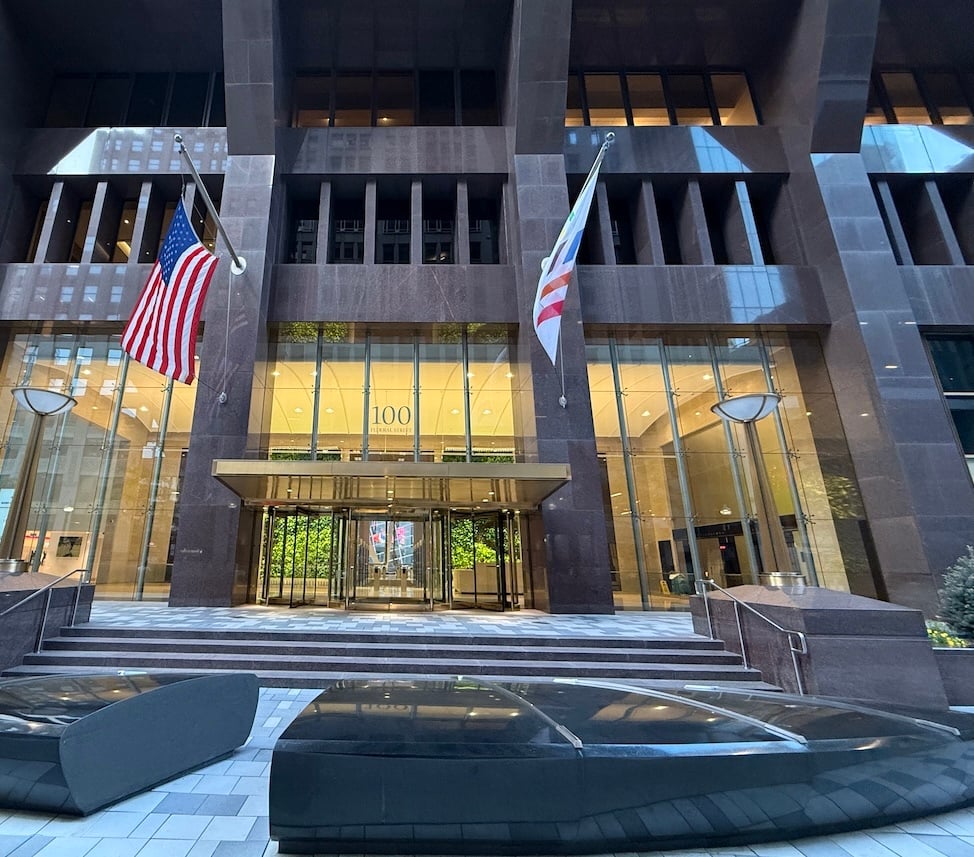
Adding ballistic protection to a bank serves two vital functions. Obviously, bandit barriers help protect staff and customers during an armed robbery. But more importantly, a well-designed ballistic barrier can prevent robbery altogether.
This deterrence effect is more pronounced as more architects become familiar with designing ballistic solutions.
Only 7% of banks targeted today have bulletproof barriers compared to 20% a decade ago. As more banks install bullet-resistant glass, would-be criminals are more likely to avoid those locations.
As an architect working with financial institutions, you are eventually going to be asked to integrate ballistic protection into your design. Here’s what you should know to start out on the right foot.
If you want to dig deeper, we offer a free online Certified CEU course for architects on the fundamentals of bullet-resistant security that’s recognized by 26 industry associations.
What Do Architects Need To Know About Ballistic Glass for Banks?
There are many physical security standards. When discussing ballistic glass and other bullet-resistant materials for building construction, the gold standard is the Underwriters Laboratories (UL) 752 Standard for Bullet-Resisting Equipment (11th Edition).
UL 752 covers both individual materials (e.g., the fiberglass panels used to reinforce drywall, sheets of laminated ballistic glass, etc.), as well as components and systems made with these materials (e.g., a bullet-resistant door with its frame, or a set-in-place ballistic transaction window).
Under the UL 752 standard, “bullet-resisting” means a material prevents both:
- Complete penetration by a bullet or bullet fragment
- Spalling (i.e., fragmentation) on the protected side of the barriers that could possibly injure a person “standing directly behind the bullet-resisting barrier”
UL 752 specifies ten levels of bullet resistance.
These levels are not incremental. You shouldn’t assume that a material rated at Level 6 will pass the Level 4 test. This is because they are designed for different threats: Level 6 materials are intended to stop a burst of many bullets from a smaller caliber weapon, while Level 4 materials must stop a single shot from a high-powered rifle.
(There is also a newer, reconfigured 12th edition of UL 752, which is organized differently. This revision has not yet been widely adopted across the security industry.)
Choosing the Right Protection Level: How Much Security Does a Bank Need?
Most architects find this infographic helpful when explaining UL bullet-resistance levels to clients. Here are the top-level points to share with your clients:
- Materials are tested and rated to stop a specific number of bullets of a specific caliber. In the real world, most UL rated materials and components massively overperform. For example, our Level 3 steel doors are rated to stop three shots from a .44 Magnum pistol, but can stop more than 100 bullets from a full range of pistols and long guns.
- Levels 1 through 3 materials will stop three-shot clusters from various common handguns
- Levels 4 through 8 materials will stop one to five shots from various rifles and submachine guns (including high-powered, sniper, and tactical rifles)
- Levels 9 and 10 are primarily used in military or certain government applications; you are unlikely to see them elsewhere
Traditionally, banks have opted for Level 1 security, but over the past decade, Level 3 security, often including enhanced forced-entry protection, has become more commonplace.
The only places most banks would opt for higher level protective barriers (usually Level 4 or 5) would be to reinforce exterior windows.
Banks usually only install these because the institution has reason to be concerned about civil unrest or extreme vandalism, or because the area is prone to stray bullets from higher-powered weapons like tactical assault rifles.
Bulletproof Windows and Doors: What Physical Security Components Should Bank Install?
Bandit barriers in banks have three primary components:
Transaction Windows
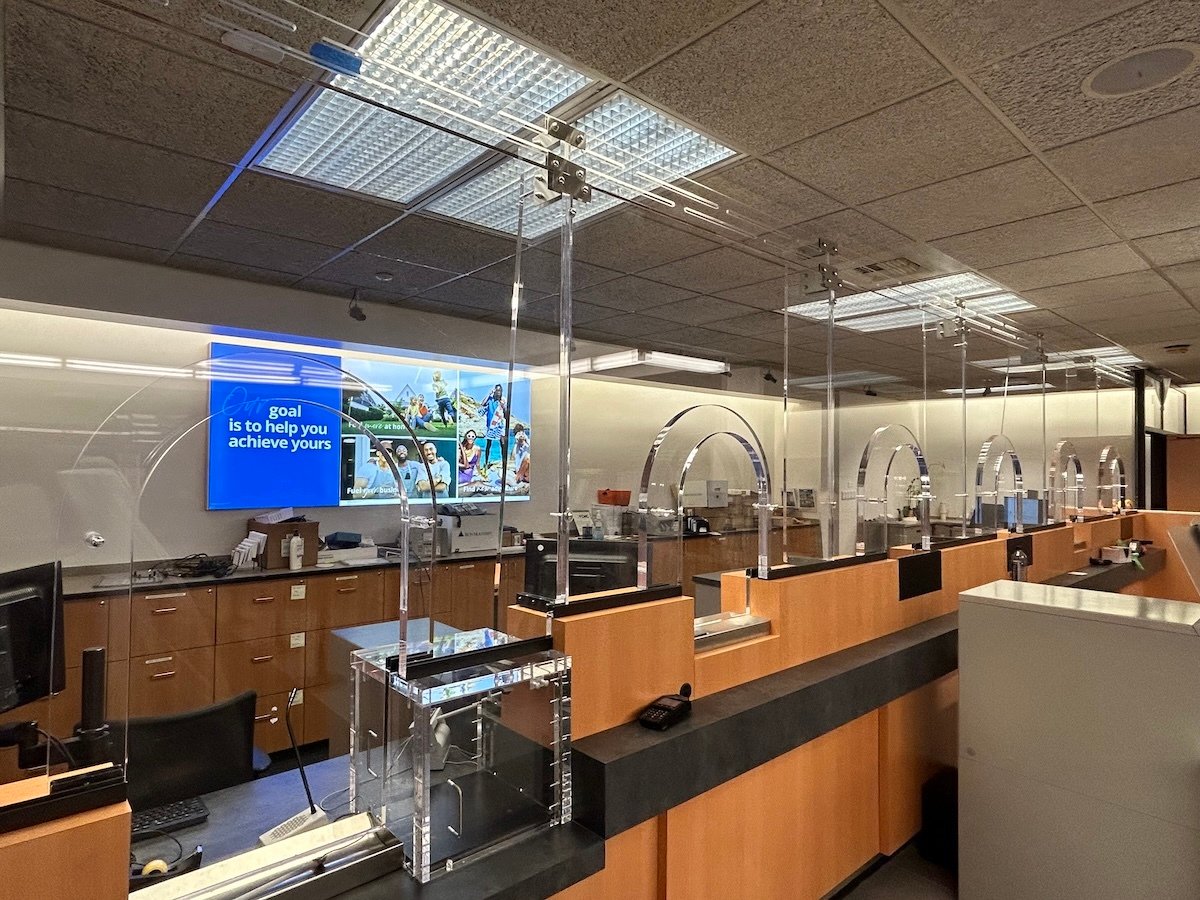
Depending on the security level the bank needs, and their aesthetic and usability goals, transaction windows might be made of bulletproof acrylic, laminated polycarbonate, or glass-clad polycarbonate, which is increasingly popular for higher-security and exterior applications.
Because these glazings are thicker than standard glass, they usually require special framing systems, which should also be tested to the same UL level of bullet resistance.
In spaces with higher ceilings, it’s common to use non-rated transparency above the bullet-resistant windows. These “jump shields” prevent attempts to go over the barrier or throw objects to harm staff. They also offer the ability to customize, and can be louvered to maintain airflow.
These windows have different speak-thru systems allowing tellers to communicate clearly with customers. Baffle and sliding window systems are common and allow the best transfer of sound. Other options, such as hole and backer systems, have smaller openings but don’t transmit sound as well.
Counters
In many banks, counters are reinforced with ballistic fiberglass.
Currency trays in the counters are ballistically rated and designed to trap bullets, rather than allowing them to ricochet. Most secure teller counters also include at least one larger bullet-resistant passer.
Bullet-Resistant Doors
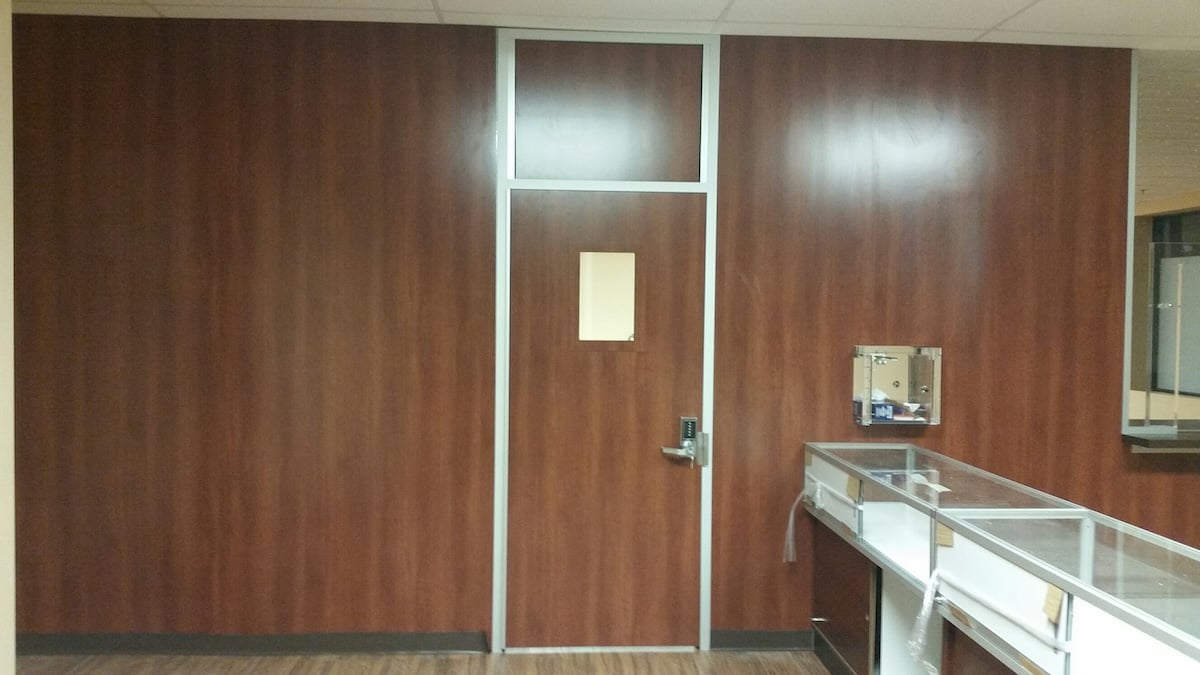
Bank barriers usually have either wood or acrylic ballistic doors.
Bullet-resistant wood doors have a fiberglass core with a wood veneer.
We regularly craft them to precisely match existing decor with a variety of windows or vision panels.
Acrylic ballistic doors can offer full visibility, and can also be partially veneered. This makes it possible to retain visual constituency with wainscoting, a half-wall, or a counter, as shown below.
Teller Lines, Entryways and More: What “Zones” Does a Bank Need to Secure?
In our experience, there are four primary zones that a bank or credit union should consider securing:
Drive-Thru Windows
The interaction of federal banking laws, industry safety standards, and local building codes strictly regulate drive-thru windows. As a result, most banks have no choice but to use one of a handful of ready-to-install, bullet-resistant assemblies.
Teller Lines
Securing the teller line is by far the most common project we design and install in banks and credit union branches. Such barriers include ballistic glazing over the counter, ballistic fiberglass underneath, secure deal trays at each station, a passer at one end, and a bullet-resistant door to access the space.
Cubicles and Consultation Offices
As more financial institutions shift to a less transactional, more consultative business, we’re seeing more front office cubicles, consultation pods, and teller pods. Properly securing these flexible office spaces means creating unique ballistic barrier systems from bulletproof glass and fiberglass. These are situations in which the customizability of acrylic doors goes a long way, preserving a bright, open floorplan while increasing security.
Entryways
Some banks opt to convert their entryway to a buzz-thru secure vestibule or custom mantrap. This can eliminate the need for additional security in the lobby and at the teller line, and can potentially help address evolving threats, like “jugging” targeting ATM customers.
Where Do Architects Run Into Trouble With Bullet Resistant Projects for Financial Institutions?
In our experience, there are two places that architects run into trouble in designing ballistic barrier systems for banks and credit unions:
- Factoring in height and weight
- Planning for long-term maintenance and repair
1. Height and Weight Constraints in Designing Bandit Barriers
A big, wide window looks amazing and offers great sightlines. But large expanses of ballistic glass aren’t practical for several reasons.
Consider this teller line, which uses a baffle window.
As you can see, the pieces of ballistic glass are offset. This allows for clear natural voice communication without any visual obstructions or distractions, like a talk-thru port or intercom. Architects often want to try removing the wickets and extending the central panel, making it wide enough to cover several tellers. That looks great—but it’s difficult to communicate through, because everyone is too far from the overlapping baffles.
Similarly, tall windows extending six or more feet up from the countertop are attractive, but create their own problems. First, a lot of money is invested on high-performance ballistic materials that are realistically only protecting some lighting fixtures.
But more important are the structural considerations. Ballistic glazing isn’t sneeze-guard acrylic or tempered glass. At eight to ten pounds per square foot, a large panel of ballistic transparency easily weighs 400 pounds or more.
You’ll need to add significant reinforcement to the counter and securely anchor the top framing to the structure itself to make that work.
This is a situation where a non-rated acrylic jump shield, like the one used below, is ideal, offering desired height with very little added weight and significantly lower cost.
2. Planning for Bulletproof Window Maintenance and Repair
If a piece of ballistic glass is hit by gunshots, it needs to be replaced. Fortunately, that’s uncommon—but replacing ballistic glazing isn’t uncommon at all. Because they’re softer than tempered glass, polycarbonate and acrylic are also prone to scratches, gouges, and marring. Tape, sticker adhesive, and even plastic clings that are harmless on glass often meld with and permanently damage acrylic or polycarbonate surfaces.
By far, the most common reason we end up replacing ballistic glass windows is because they’ve been damaged by improper cleaning. Commercial and household glass cleaners are formulated for tempered glass, and are much too harsh for the plastics used in ballistic windows. This causes ugly hazing and “crazing.” It doesn’t compromise ballistic safety, but can ruin visibility.
You should design with the knowledge that the teller window will need to be replaced someday. Concealing the framing system in the counter or an overhead soffit, as many architects would prefer, makes a quick ballistic glass swap into an expensive undertaking.
Your Partner for Credit Union and Bank Security Projects
At TSS, we have decades of experience with bulletproof protection. We’ve created countless bandit barriers and bank transaction windows, deterring potential threats, protecting people during dangerous events, and looked good while doing so. Our experienced ballistics experts are eager to help you determine threat levels, design a barrier, and plan for installation.
As a rule, we want to ensure every workplace has maximum protection, and every architect delivers the best work they can—even if it is their first time addressing firearm threats in their design. We’re pleased to make free materials available and courses that support good, comprehensive security planning and physical protection system design.
If you have any questions, or are ready to begin moving forward with a project, we’re here to help. Simply send us a message online to get started.