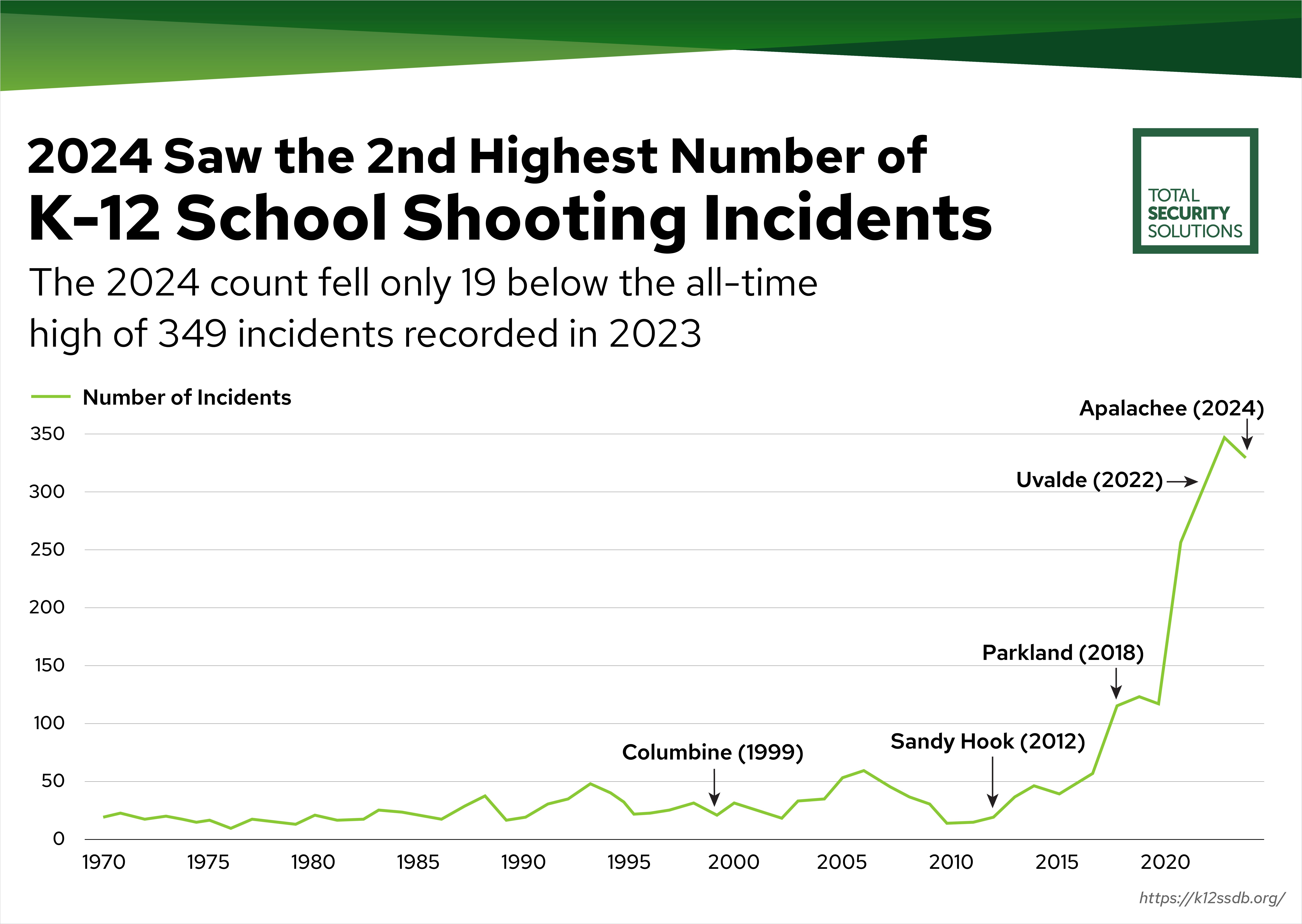
First, the good news: The United States saw an encouraging reduction in school shootings in 2025, according to the K-12 School Shooting Database—the second such reduction in a row.
Unfortunately, school shooting incidents reached a near record high in 2024, and even these new reduced rates are still roughly twice what they were pre-pandemic, as you can see in this chart:
Anxiety about school safety remains at record highs. Taking steps to increase physical security is a rational response.
Some states, including California, Connecticut, Kentucky, Ohio, and Tennessee, even have specific requirements for school doors, such as resisting forced entry, preventing fires from spreading, and locking from the inside.
At Total Security Solutions we draw on decades of experience with physical security and ballistic materials. We’ve designed, fabricated, and installed thousands of school security projects using a systems approach in which sets of ballistic and forced-entry rated components are brought together with integrated access control and monitoring systems to create layers of security.
Here are our top recommendations for protecting students and faculty from the moment they enter.
Focus on a Single Point of Entry
As a rule, it’s best to funnel all students and visitors into the building through a single monitored, access controlled secure entryway.
All other exterior doors should be treated as emergency exits. Don’t leave them unlocked, and discourage their routine use as entrances by staff, coaches, and vendors.
Classroom doors should be intruder-resistant and lockable.
Many larger schools choose to compartmentalize their interior space further with “interior entryways” that can contain an attacker much as fire-rated hallways and stairwell doors prevent the spread of fire without slowing evacuation.
Types of Security Doors for Schools: Exterior and Interior Security Doors
We have a wide range of ballistic doors available, depending on your needs.
This in-depth resource can help you get a handle on your options, but in general, school security doors fall into two broad categories: Exterior and Interior.
Exterior Security Doors for Schools: Bullet-Resistant Entryways and Secure Emergency Exits
A secure school has one main entryway. All other exterior doors should be treated as emergency exits that cannot be opened from the outside.
The main entryway is your first line of defense. Most schools are now moving toward a “secure vestibule” for their main entryway. This is one of the most cost-effective ways to rapidly increase school safety.
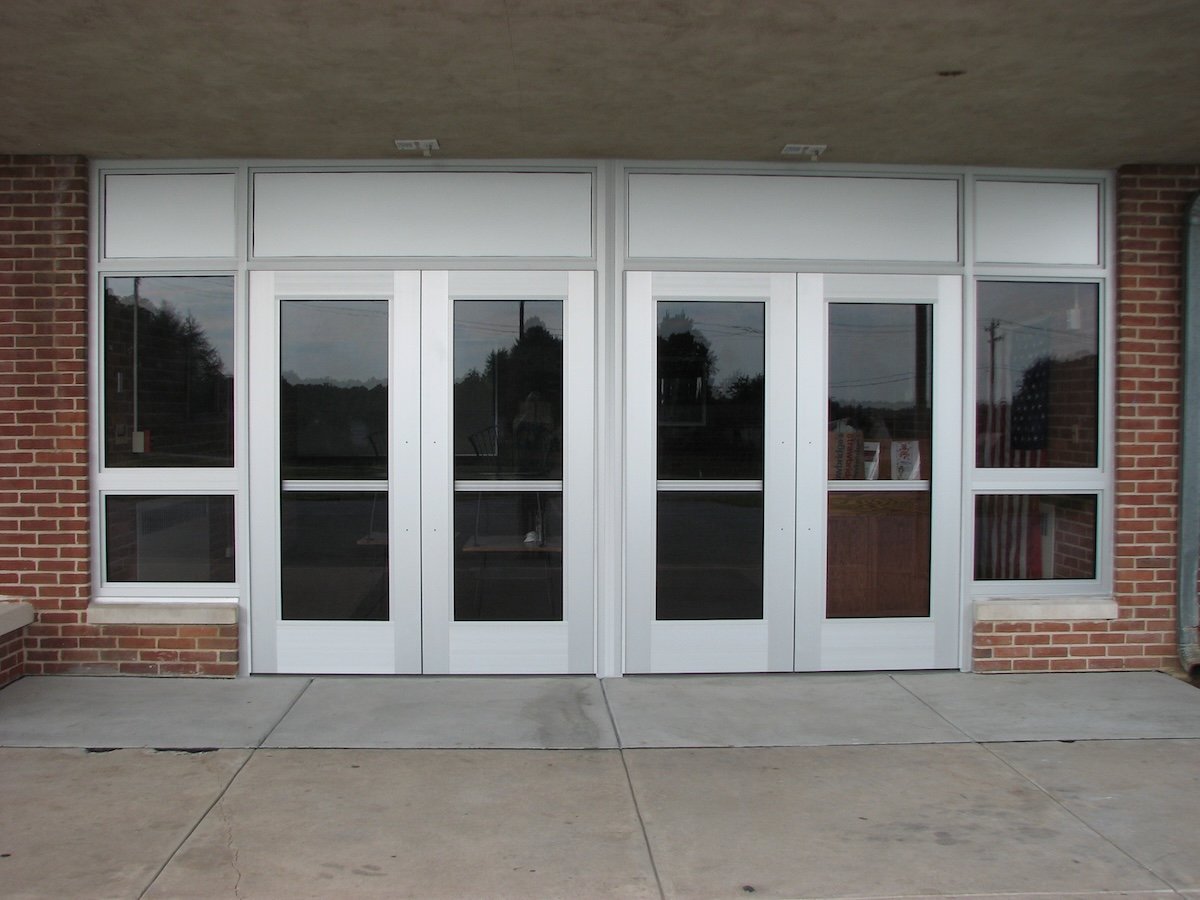
A secure vestibule looks like any other school entryway.
It has two sets of metal-framed “glass” doors and a vestibule between. Visitors can freely enter the exterior doors but cannot move past the locked interior vestibule doors before checking in, either at a secure transaction window or using a voice or video intercom.
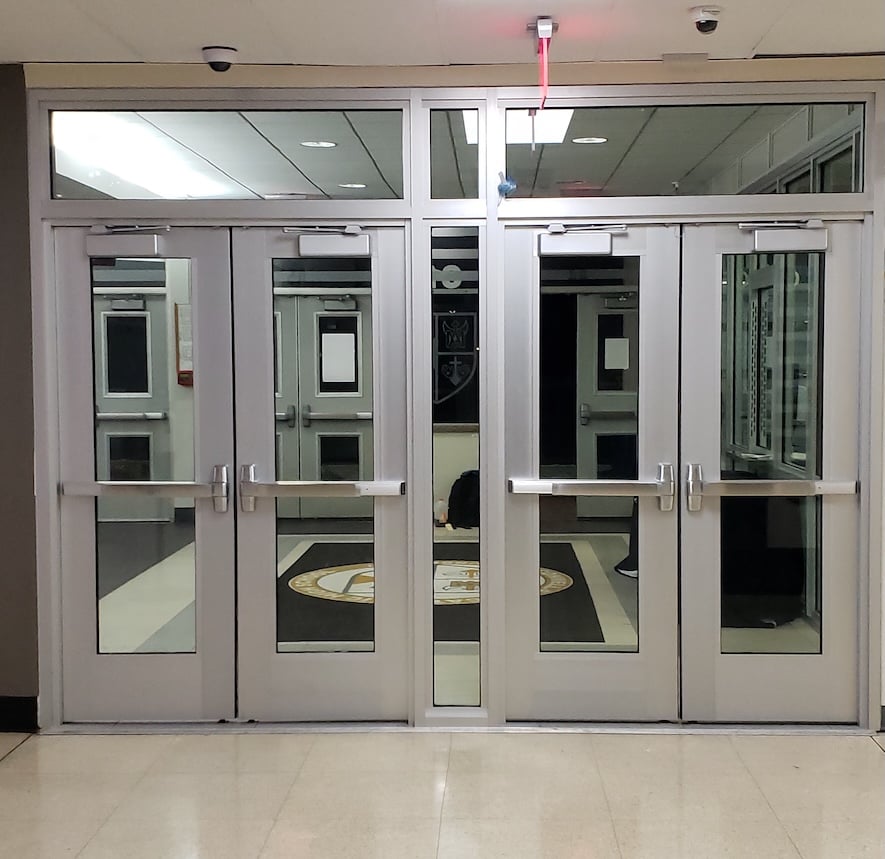
Those interior vestibule doors look like the aluminum and glass storefront commercial doors you see on many office buildings and retail stores, but they are actually ballistically rated aluminum doors.
Most schools will want UL Level 3 doors, which are tested to withstand attacks from any common handgun and will deter forced entry.
These are among the most popular doors TSS installs. We regularly collaborate with security integrators and contractors to prepare these doors to allow for security system wireruns and accept whatever access control system or door hardware the school prefers.
Exterior doors other than the main entryway should be treated as “emergency exits,” and never left unlocked. These should be either bullet-resistant aluminum doors, UL-rated steel ballistic doors, or steel security doors. Steel doors should allow for people to check for danger prior to pushing through.
In a school a full-length side lite window is best, but half vision windows are also good.
For ballistic doors, a UL Level 3 rating is most popular.
If your school doesn’t have the budget to upgrade secondary exterior exits to bullet-resistant or forced-entry rated doors, you should at least make sure they have quality commercial doors made of 18-gauge steel (or thicker).
The glazing for any doorway window should be tested against a meaningful forced-entry standard, like ASTM F1233, which covers multi-staged forced-entry attempts.
We developed our SchoolDefender®glass specifically for situations like these where ballistic security is less necessary, but you need a window that will withstand attempts at vandalism and forced entry.
Interior Security Doors: Classroom Safety and Intrusion Resistance
Ideally, all classroom doors and hallway doors would be at least bulletproof wood doors or bulletproof steel doors tested to UL 752 Level 1, with bullet resistant glass windows rated to stop multiple shots from a 9mm handgun.
Ideally, windows should also be forced-entry rated and tested against a standard like ASTM F1233.
If you need doors to be fire rated, ASTM E119 is the industry standard that measures how long a door can contain fire.
UL 263 is a similar standard that tests assemblies under fire conditions and may be required by some building codes.
Given the prevalence of building-wide sprinkler systems, schools may opt-out fire-rated security doors on classrooms or other areas where allowed by local building codes.
The exception would be rooms like science labs, kitchens, or workshops, which tend to have an elevated risk of fires. In those cases, a school might need to select a door that is both fire-rated and offers bullet-resistance and delayed entry. Some ballistic steel doors could be suitable, depending on local and state regulations.
Some larger schools add “interior storefronts” at strategic points in the building.
These are essentially the same as the bullet-resistant interior portion of the secure entryway, and capable of being remotely locked down. This allows school administrators to compartmentalize the building in an emergency.
Similarly, some interior doorways, like those at stairwells, hallways, or science labs, are a good fit for the same kind of ballistic steel security doors used at secondary exterior exits.
Key Features To Look for in Classroom Doors
Classroom doors need to balance daily usability with worst-case-scenario performance, while meeting accessibility and life-safety expectations.
The three most important considerations are locking mechanisms, windows, and ADA compliance.
Door Locking Systems for Classrooms
Choose classroom door hardware that can be locked from inside without opening the door, but is still accessible to first responders. Any room occupant should be able to lock the door, not just a teacher with a key.
Ideally, the lockset should feature a clear visual indicator that the door is locked.
In most cases, schools will use a simple and intuitive thumb-turn on the inside of the door knob, with an exterior lock responders can release with a passkey.
Some schools have explored building-wide electronic access control systems.
This can expedite both locking down during an emergency and selectively providing responders access to rooms as they clear the building. A few states have begun to explore requiring such systems in new construction for schools.
It's important to note that any locking system should never prevent or delay people inside the room from getting out.
In recent years, an increasing number of small companies have marketed “school door barricades” that can be added to existing doors.
“Door barricades” are a non-standard style of secondary door lock, usually using an additional wedge, bracket, or cleat to secure the door to the floor or its frame.
These aftermarket classroom door barricades are dangerously out of line with safety guidelines and building codes.
Every expert we’ve spoken to has cited the same issues.
They prevent emergency responders from gaining entry to render aid, potentially trap students and staff if the barricade malfunctions, and almost invariably violate the Americans with Disabilities Act, fire codes, NFPA life safety guidelines, and best practice guidelines for school building safety.
Glass Panels for School Safety
Classroom windows looking out into the hall (often called "vision panels") play a vital safety and security role, so much so that the Department of Homeland Security (DHS) recommends them, provided they can be covered during a lockdown.
Vision panels create “natural surveillance.” They don’t just allow teachers to look out for danger in an emergency or to passively monitor the hall, but also make it easy for passing staff to glance into an “empty” room.
But during an active attacker scenario, that same window can become a liability if the attacker can smash out the glass and reach through to unlock the door.
Vision panels in classroom doors should be designed to deter forced entry.
Bullet-resistant low-spall UL Level 1 glass-clad polycarbonate (GCP) is popular with schools, both for its bullet resistance and general durability. Another great option is a tested forced-entry rated window like TSS’s SchoolDefender® glass.
This glazing does not stop bullets but also does not fragment or shatter when shot, which significantly slows attempts to gain entry.
ADA Compliance
Doors designed for a school should meet ADA standards.
That includes:
- Having thresholds with appropriate width
- Adequate clearance to move in and out
- Door hardware mounted an appropriate distance from the ground
- Viewing panels no higher than 43 inches
- Taking at least five seconds to close and not requiring more than five pounds of force to open
ADA compliance becomes an issue with security and ballistic doors, which can be much heavier than standard commercial doors.
If improperly installed or maintained, school security doors can deviate from this standard over time. TSS has engineered high-security doors for special cases, such as federal facilities, that are 500 pounds or heavier and still open with the required five pounds of force and gently close per ADA guidelines.
Many trainings encourage teachers to improvise secondary door locks for their rooms.
This may keep out an attacker in a pinch, but like commercial door barricades, they will also slow responders and could prove deadly during other emergencies like fire.
Cost Considerations and Budgeting
The cost of a physical security upgrade for a school is going to vary depending on material, protection levels, and the extent of the solution.
The best way to get an estimate for your project is always going to be speaking with an expert who can provide exact figures based on your specific facility and needs.
In general, the cost of ballistic doors starts at $3,500 for standard steel doors tested to UL 752 Level 1.
Aluminum storefront doors tested to Level 3, suitable for an entryway, would be several thousand more.
Ballistic wooden doors start in the same price range, but are harder to generalize because there are so many different veneer, hardware, and window options.
That said, a reliable security solution is more than just swapping commercial doors for bullet resistant doors.
In most school buildings, the doors will be one element of a system that also includes security glazing, bullet-resistant framing, ballistic paneling for walls, access control and monitoring system integration and more, which can make budgeting seem daunting.
In addition to federal grants to defray the cost of security improvements, many states offer their own grants, which school administrators can search at SchoolSafety.gov’s Finder Tool.
A few examples of state-specific grants include:
- Ohio School Safety Grant Funding: Ohio offers $11 million in school safety grants to districts to cover various initiatives, such as active-shooter training or equipment, alarm systems, certification for school resource officers, and training to identify and help students with mental health issues.
- Indiana’s School Safety Grant Program: This program supports conducting safety assessments, hiring school resources officers, or purchasing “equipment, hardware, materials and technology” to restrict access to school property or classrooms, assist with visitor management, notify first responders, alert school staff about open or closed interior and exterior doors, and more.
- Pennsylvania’s School Safety and Mental Health Grants: Pennsylvania allocated $100 million in 2024 for physical security upgrades, mental health services, school police officers, and emergency planning.
- Texas School Safety Standards Grants: Taxes made these grants available on a three-year cycle starting in 2022 to help schools cover security-related costs like metal detectors, cameras, silent panic alert systems, and monitoring tools.
Never applied for a grant before? Check out these tips for writing successful school grants.
Why Choose TSS Bulletproof for School Security
At TSS, we specialize in helping schools find physical security solutions that are attractive, effective, and work with their budget. Good solutions always start with education and exploration.
We have decades of experience helping schools across the country stay safe, and are pleased to share that knowledge through free resources that support good, comprehensive security planning.
If you have questions or are ready to begin moving forward with a project, we’re here to help.
Our experienced ballistics experts can help you determine your threat level, design a barrier, and plan for installation.
Schedule a consultation to get started.