Eric Hatty | |
There’s no way to truly measure the impact of a physical security breach, especially one that results in injuries or lost lives. Each loss leaves behind a grieving family and an entire community that feels the absence. Employees feel a heightened sense of anxiety at the very least and may experience post-traumatic stress that lingers.
And companies are feeling the pressure to protect people.
Eighty-three percent said there are greater demands on front-line security professionals today than there were five years ago, according to the latest Allied Universal World Security Report, which surveyed more than 2,300 chief security officers across 31 countries.
The report details the financial impact of security incidents and offers insight into physical security best practices, including where companies are investing and what solutions they’re implementing.
We'll pair that data with proven physical security measures we've seen work across more than 30,000 installations, including protecting thousands of corporate offices.
How Do Companies Prioritize Physical Security?
Physical security has moved up the corporate agenda, and the report’s survey data shows this.
Sixty-six percent of chief security officers expect their physical security budgets to increase in the next year, and 82% say physical security should be a higher strategic priority than it currently is. Among institutional investors, that figure climbs to 92%.
The threat picture explains the shift. A few numbers worth noting:
- 458 workplace homicides occurred in 2023, according to the Bureau of Labor Statistics, and 81% involved gunshot wounds.
- 42% of chief security officers say violence toward executives is increasing
- A significant security event can reduce the value of a publicly traded company by 32%, according to Global Institutional Investors.
- 26% of companies lost revenue following a security incident.
- Companies lost $9 million in revenue on average
Physical security threats span a wide range, including external threats like armed intruders and burglary, internal risks from current or former employees, and even natural disasters that can damage infrastructure and knock security systems offline. A solid physical security plan has to account for all of them.
Companies are no longer questioning whether to invest in security, but how to budget accordingly to meet their growing needs.
The Foundation: The 5 D's of Physical Security
Before getting into specific physical security controls, it helps to understand the framework most security professionals build around. Effective physical security follows the 5 D's, a layered defense model where each layer performsdoes a distinct job:
- Deter: Make your facility an unattractive target. Visible security cameras, lighting, signage, and fencing discourage an attacker before they act.
- Detect: Identify a threat early. Motion sensors, alarm systems, and surveillance systems alert security teams the moment something is wrong.
- Deny: Block unauthorized access. Access control systems, locks, guard booths, and physical barriers, such as perimeter fencing, keep intruders out.
- Delay: Slow an attacker who has breached the perimeter. Secure entryways that include bullet-resistant doors and doors tested to resist forced entry buy time for people to reach safety and for law enforcement to respond.
- Defend: Protect people during an incident. Safe rooms, ballistic barriers, and trained response give employees a fighting chance.
No single measure stops every threat, so effective physical security stacks multiple layers. If a video surveillance system misses something, an access control system catches it. If someone breaches a physical barrier, a safe room protects the people inside.
Physical Security Best Practices Companies Are Prioritizing
When it comes to implementing physical security measures, these are the top three budget priorities globally:
- Investment in new security technology and infrastructure (47%)
- Employee security training and upskilling (45%)
- Conducting security risk assessments and threat intelligence analysis (44%)
The best practices below map directly to those priorities.
1. Start With a Security Risk Assessment
Every effective physical security plan begins with a risk assessment. You can't protect against physical security risks you haven't identified.
A good risk assessment documents all entry points and potential breach locations, evaluates whether entrances are clearly visible and well-controlled, and examines if high-risk areas like executive suites have physical barriers and oversight. It should also analyze past security incidents and regional crime statistics to ground the plan in real-world data.
Conduct risk assessments annually, at minimum. Threats evolve, and regular risk assessments help your company set the right priorities as you budget for upgrades.
If you're starting from scratch, our workplace violence risk assessment template walks you through the critical factors and gives you a repeatable framework for quarterly reviews.
2. Put Physical Security Policies in Writing and Train Employees
Most companies have a detailed cybersecurity policy. Far fewer have written physical security policies.
Clear physical security policies set expectations for everyone in the building. A strong policy states a zero-tolerance stance on violence and harassment and gives employees an easy way to report threats or suspicious activity while designating a plan for responding.
FBI behavioral research found that 80 to 90% of shooters leaked warning signs before acting, such as making verbal threats or hinting at their plans on social media.
Your plan should also spell out emergency procedures, such as evacuation, shelter-in-place, and communication protocols. Assign clear roles so no one is guessing during a crisis.
Many school districts train their staff to respond to emergencies using frameworks like the Standard Response Protocol, and workplaces can adapt these for employees.
Written security protocols only work if people can find them and understand them. Reinforce the policy through regular training, and be sure it’s part of your new employee onboarding checklist.
3. Build Physical Barriers, Starting at the Perimeter
While physical barriers are the first line of defense. Perimeter security — fencing, gates, bollards, controlled access points, and clear signage — establishes a controlled boundary and forces anyone approaching the building through a monitored path.
Lighting is an underrated physical security measure in this context. Good lighting eliminates hiding spots and improves visibility in unsecured areas, and it makes your security cameras far more effective. Aim for a minimum of 5 foot-candles of illumination at entry points.
Inside the building, layered barriers protect people where it counts. This is where our work at TSS focuses.
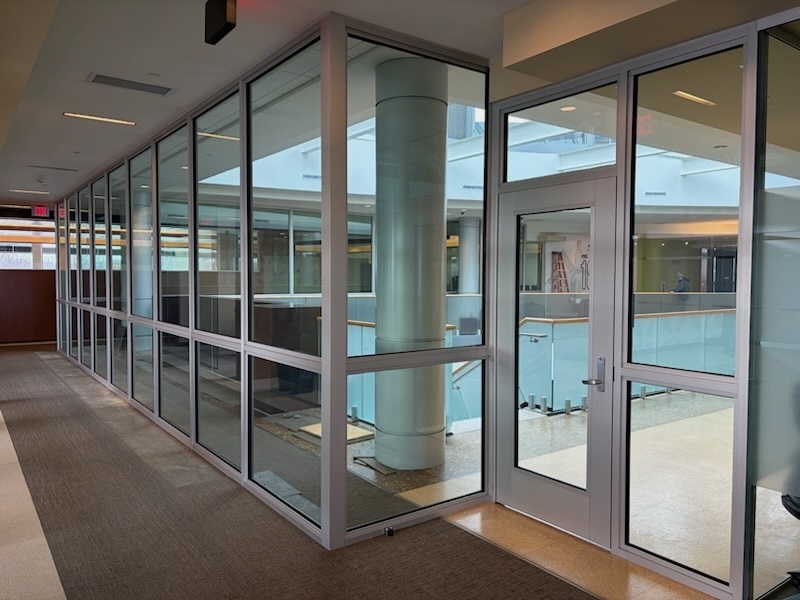
We design and build bullet-resistant doors and entryways tested to UL 752 and ASTM forced-entry standards, bullet-resistant windows for vulnerable areas like executive offices, transaction windows for lobbies and reception, and ballistic fiberglass panels that turn a reception desk into a place employees can shelter.
Many companies also convert an existing conference room into a safe room with reinforced walls, doors, and ballistic glazing. Rather than stop an attacker at the door, these upgrades buy the seconds and minutes that let people reach safety and give law enforcement time to arrive.
4. Protect High-Risk Areas and Executives
Executive offices and boardrooms have become a priority for physical security upgrades, and the threat data explains why. With 42% of CSOs reporting rising threats against leaders, these spaces increasingly call for enhanced protection.
The challenge is doing it without turning the executive floor into a bunker. Our executive protection solutions blend into your office design, including backglazing, reinforced walls, and secure entryways to executive floors.
5. Use Access Control Systems
Access control is one of the highest-leverage physical security controls a company can implement. Access control systems restrict entry to authorized individuals and log every entry, giving your security team a record of access events for audits and investigations.
Modern access control systems use keycards, biometrics, or mobile credentials in place of traditional keys. Each approach helps deter unauthorized access in a different way:
- RFID keycards and badges are the corporate standard. They’re easy to issue and revoke.
- Biometrics (such as fingerprinting and facial recognition) tie access to a specific person and are difficult to duplicate.
- Mobile credentials let you push instant access updates to an employee's smartphone so a departing employee's access disappears the moment they leave.
Keyless access control also removes the risk of lost or duplicated keys, a common weak point in older physical security systems.
And two-factor authentication on your access control systems adds a second layer so a stolen badge alone won't grant entry.
When access control systems sync with your HR database, you can deactivate a former employee's credentials instantly, closing one of the most common gaps that lets unauthorized entry happen.
Our team can design physical security elements that work with these systems, such as all-glass bulletproof doors that lock down without the proper credentials.
6. Use Surveillance Systems
Video surveillance deters intruders and collects evidence when an incident does occur.
Surveillance systems should cover every entry point and any area holding sensitive data or valuable assets. Blind spots are where security breaches start.
A few standards to consider if you’re planning to implement security cameras:
- Use 4K-resolution cameras where identification matters. Grainy footage that can't identify a face has limited value as evidence.
- Add AI-powered analytics. Today’s surveillance systems can detect suspicious behavior patterns, such as loitering or tailgating, and alert security teams before an incident escalates.
- Move to cloud-based video management. Cloud CCTV systems enable remote monitoring and scalable storage, letting a small team monitor multiple locations from one place.
Pairing video surveillance with intrusion detection systems and motion sensors gives you detection coverage around the clock. When a motion sensor trips after hours, the camera feed tells your security personnel whether it's a real threat or a false alarm.
7. Align Physical Security Technology With Your People
Even the most advanced physical security technology is only as good as the people using it. This is the point CSOs consistently emphasize, and the data backs them: 87% say frontline security professionals will always play an essential role, even as AI adoption grows.
Advanced physical security technology works best when it fits your team's workflows:
- Camera systems with AI-based motion detection alert security personnel to unusual behavior before it escalates.
- Mobile panic buttons save valuable seconds during a crisis.
- Visitor management systems require identification and logging of every guest, closing a gap that unstaffed lobbies leave wide open.
You don’t necessarily need a dozen different vendors to meet your needs. In fact, it’s better if you work with just a few strategic partners to develop a unified security strategy, especially if you’re protecting multiple sites across a large organization.
Working with one physical security solutions provider can help you develop a standardized approach that’s easier to implement because you’re creating one plan versus a dozen.
Companies that have strong relationships with security vendors who handle the majority of their needs report significantly higher confidence in dealing with threats (79% compared to 51% for those with low vendor involvement), according to the World Security Report.
8. Connect Physical Security to Cybersecurity
A complete physical security plan prepares for worst-case scenarios, including active-threat events, natural disasters, and major security breaches. That means having documented incident-response protocols, multi-modal communication plans, and continuity-of-operations plans that keep the business running after an incident.
Integrating physical security with cybersecurity is also critical because the two are closely related. A physical breach can become a data breach in minutes if someone gains access to company servers.
Insider threats account for up to 60% of data breaches, according to Verizon’s 2026 Data Breach Report, and many begin with physical access.
How Total Security Solutions Supports Your Physical Security Plan
At Total Security Solutions, we have more than 20 years of experience developing custom ballistic barriers that delay entry and protect people where it matters most. We design our systems in-house to support your operations and building design, with materials tested to industry standards for bullet resistance and forced entry resistance. That includes helping you specify the right level and accessories so everything works together as a complete system.
It all starts with a discussion about your concerns and an assessment of your risks. From there, we’ll work closely with you to recommend solutions that align with your needs.
We also deliver and install the systems with trained crews so you avoid on-site issues or change orders.
Download the Workplace Violence Risk Assessment Template & Planning Guide to identify your vulnerabilities.
Then schedule a consultation with our team when you're ready.